
Views: 0 Author: Kun Tang Publish Time: 2025-10-24 Origin: Jinan YZH Machinery Equipment Co., Ltd.
In my years at the helm of Jinan YZH Machinery Equipment Co., Ltd., I've seen firsthand how a single bottleneck at a crusher mouth can bring an entire operation to a grinding halt. The resulting downtime isn't just frustrating; it's incredibly expensive. The solution? A powerful, reliable, and perfectly suited Rockbreaker Boom System.
But choosing the right system isn't as simple as picking one from a catalog. It's a critical investment that demands a careful, systematic approach. A misstep can lead to underperformance, safety risks, and a rapid erosion of your ROI.
This guide is designed to cut through the noise. It’s the same process our experts at YZH use when consulting with clients worldwide. Follow these ten steps to transform your site conditions into a clear technical specification, ensuring you select a system that delivers safety, efficiency, and long-term value.
Your workplace sets the stage for every decision. The demands of an underground mine are vastly different from those of an open-pit quarry.
Underground Operations: Space is at a premium, and ventilation or explosion-proof constraints are non-negotiable. Here, you must prioritize compact booms with a precise reach, wide rotation angles, and the capability for remote operation to keep personnel safe.
Opencast Mines: These sites demand wide coverage and resilience against large temperature swings, wind, and dust. Opt for a longer reach, higher structural stiffness, and robust weather protection to ensure consistent performance.
Aggregate Plants: With a stable, high-cadence operation, the cost of downtime is paramount. Your focus should be on reliability, seamless integration with plant automation, and components designed for fast, easy maintenance.
Specialized Applications (Metallurgy, Recycling, Ports): Consider unique challenges like extreme heat, corrosive dust, or confined access. These environments often call for customized solutions.
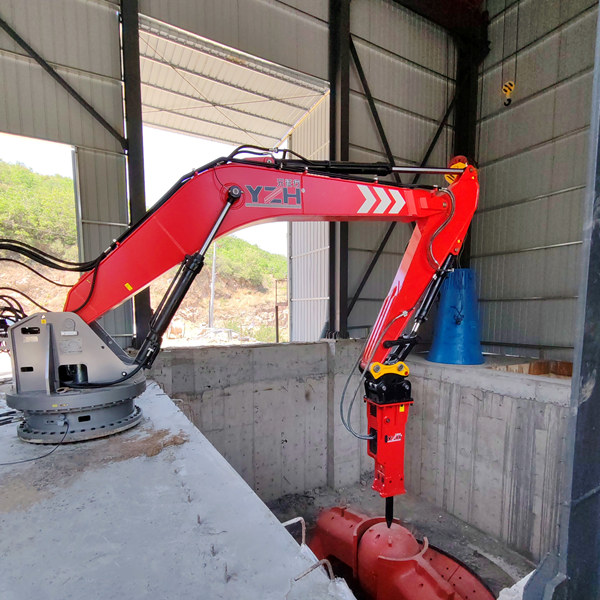
The rock itself dictates the power and tooling you'll need. Don't guess; get the data.
Rock Type and Hardness: Provide a recognized hardness index, such as Uniaxial Compressive Strength (UCS), Mohs, or Protodyakonov. Harder rock requires a breaker with higher impact energy and a more robust structure.
Maximum Rock Size: This directly drives the required boom reach, working radius, and breaker energy. If you have the data, share the D95 or D100 block size with your supplier.
Rocks per Hour: This figure determines the required cycle rate and influences the thermal design of the hydraulic system, ensuring it can handle continuous operation without overheating.
Where will the boom be working? The location dictates the geometry of the entire system.
Location: Is it the crusher mouth, a rock box, or a grizzly screen? Each location demands different coverage patterns and mounting heights.
Crusher Type and Brand: Jaw, impact, or gyratory crushers all have different geometries. Providing the specific model helps engineers perform interference checks and ensure optimal access angles.
Grizzly Size and Mesh: The dimensions of your grizzly screen set the precision requirements at the tool tip, helping to avoid damage to the beams or screen itself during operation.
Now, let's get specific about performance. These numbers are the backbone of your technical specification.
Rotation Angle: Aim for a minimum of 170° to cover the critical zones around the crusher without having to reposition the base.
Work Area Envelope: Provide detailed plan and elevation drawings. This allows for precise validation of the boom length, joint angles, and any potential dead zones.
Working Hours per Day: This impacts the system's duty cycle, cooling capacity, and recommended service intervals.
Site Temperature Range (Max/Min): Extreme temperatures guide the selection of seals, hydraulic oil grades, and the need for accessories like cold-start kits or heat shielding.
Power Supply (Voltage & Frequency): Ensure the electric motor and control systems are compatible with your local standards (e.g., 50/60 Hz, specific voltage).
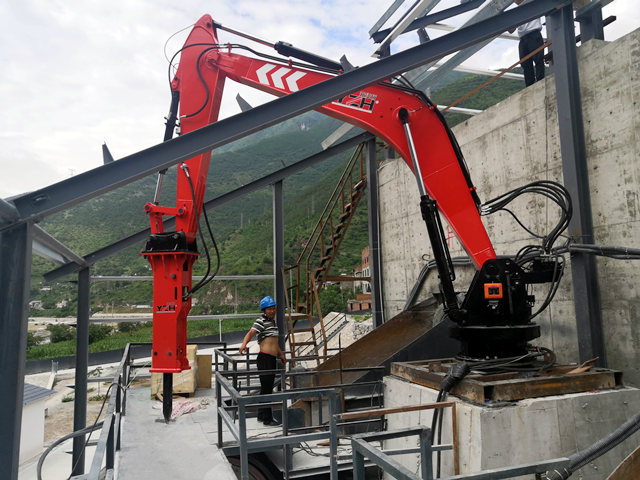
This is where the data comes together. When evaluating a Rockbreaker Boom System, focus on these key metrics:
Maximum and effective reach
Coverage sector and rotation radius
Degrees of freedom (boom, stick, swing)
Base height and mounting interface
Crucially, validate the coverage. Use your drawings to verify that the boom can access the crusher mouth, rock box corners, and the full grizzly span in its "worst-case posture." Always build in a 10-15% margin for both reach and energy. Don't forget to check the structural strength—boom section width, pin diameter, and slewing bearing capacity must be up to the task, especially for heavy raking.
The boom is the arm; the breaker is the fist. They must be perfectly matched.
Tool Type:
Blunt: Best for reducing large boulders, providing efficient energy transfer.
Moil/Chisel (Point/Flat): Ideal for initiating cracks in hard rock, precise spot breaking, and clearing jams.
Cone/Round: A good general-purpose option, offering a balance between wear and breaking performance.
Accumulator or Not?
With Accumulator: Delivers smoother energy, better handles peak loads, and is suited for high-frequency tasks.
Without Accumulator: Simpler design with easier maintenance, but may require a more conservative duty cycle.
The matching principle is simple: size the breaker's impact energy (Joules) and blow rate (bpm) to the rock hardness, block size, and your desired cycle time. Ensure your hydraulic power unit and boom structure can support the breaker's pressure and flow requirements without creating a bottleneck.
A world-class system on a weak foundation is a recipe for disaster.
Concrete Foundation: Offers superior vibration absorption for fixed plants. It must be engineered to handle both dynamic and impact loads, with proper rebar and anchor bolts specified.
Steel Structure: Allows for faster installation and is ideal for retrofits. Ensure the structure is checked for buckling and fatigue, and add stiffeners and vibration isolation pads where needed.
How the operator interacts with the system is critical for both safety and productivity.
2-in-1 Radio Remote: The industry standard for flexibility, allowing the operator to maintain a safe distance while having a clear line of sight.
Cabin Control: Perfect for centralized control rooms, integrating easily with Distributed Control Systems (DCS) or PLCs.
5G Teleoperation: The cutting-edge solution for hazardous or restricted-access areas. This requires planning for network redundancy, low-latency video feeds, and a local hard-wired E-stop.
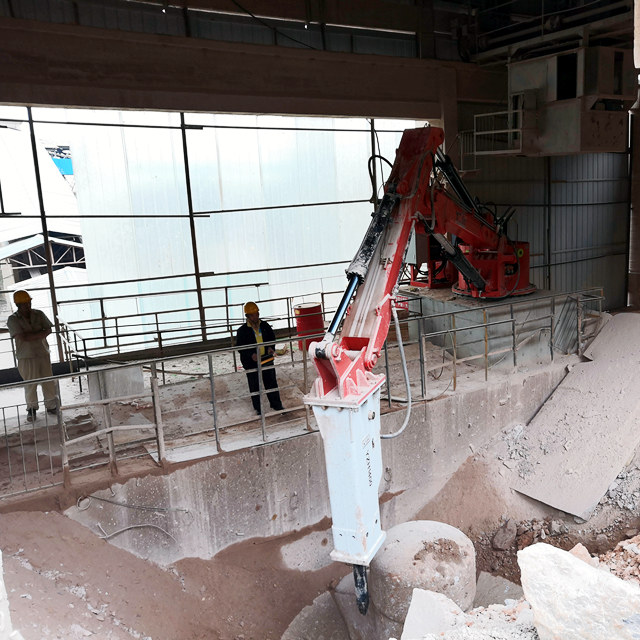
The HPU is the heart of the system. Its selection and placement are vital.
HPU Essentials: Specify the pump type (fixed or variable displacement), installed power, reservoir volume, cooling method (air or water), filtration class, and any needs for cold-start heaters or thermal shielding.
Placement:
Near the Base: Minimizes pressure drop and improves hydraulic response.
Remote/Clean Area: Often preferred in hot, dusty environments to protect the unit. This requires protected manifolds and carefully routed lines, but always ensure there is adequate service access and lifting points.
A great system is more than the sum of its parts. It's how it all works together safely.
Interlocks and Automation: Integrate the boom with your plant logic. This includes E-stops, limit switches, feed/chute interlocks, and camera systems for enhanced visibility.
Hose and Guarding: Use a combination of rigid and flexible lines. Add abrasion sleeves at articulation points and heat shields near hot surfaces like crusher mouths.
Maintenance Plan: Be proactive. Define replacement cycles for tool bits, seals, bushings, and pins. Stock a critical spare kit and schedule regular inspections for fasteners and structural welds.
Focusing Only on Maximum Reach: Effective coverage depends on rotation angle, joint limits, and approach geometry.
Oversizing or Undersizing the Breaker: Too large risks overloading the boom structure and causing fatigue; too small leads to slow clearing and thermal stress on the breaker.
Under-Designed Foundations: Ignoring dynamic loads leads to loosened anchors and concrete cracks. Always perform a proper dynamic analysis.
Overlooking Temperature and Power Compatibility: This can cause cold-start failures, overheating, or control system malfunctions.
To get a fast and accurate quote from a supplier like YZH, provide this information:
Workplace: Underground/opencast/aggregate/other, with photos and layout drawings.
Rock Data: Hardness index, D95/D100 block size, rocks per hour.
Operation: Crusher type/model or grizzly dimensions; required coverage area (plan + elevation).
Requirements: Rotation angle, daily operating hours, site temperature range.
Power: Voltage and frequency.
Preferences: Tool type, accumulator (yes/no), control mode.
Foundation: Concrete or steel, with load capacity and interface details.
HPU: Power/cooling/filtration needs, preferred location.
Safety/Automation: E-stops, limits, video, interlocks.
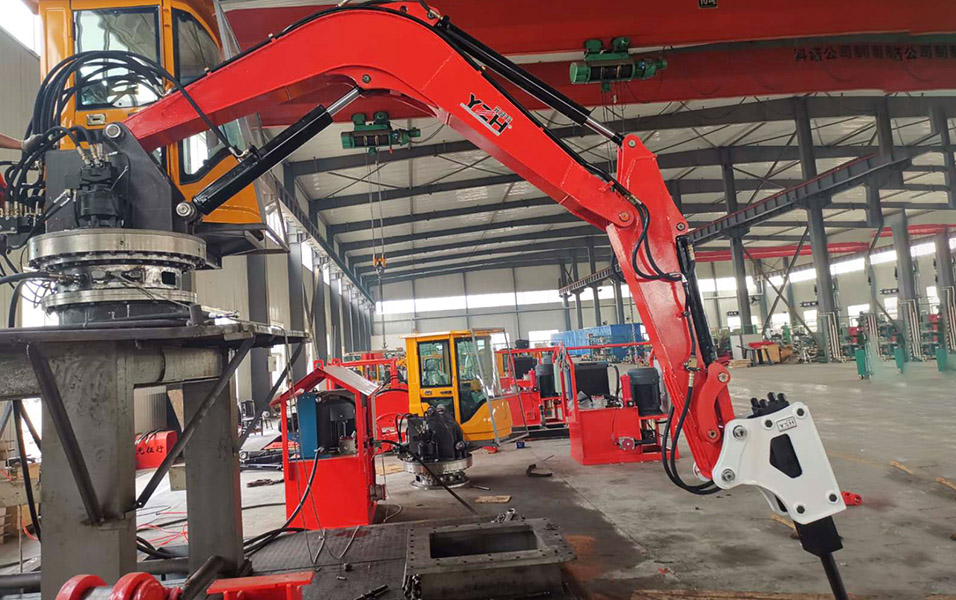
Choosing a Rockbreaker Boom System is about closing the loop between your site's reality and the equipment's capability. By following this structured ten-step process, you lock in the right parameters early, reduce rework, minimize downtime, and build a safer, more efficient operation.
At YZH, we don't just sell equipment; we engineer solutions. Our team is ready to help you convert your site data into a final, high-performance specification.
Contact us today for a rapid, no-obligation assessment. Let's ensure your operation never misses a beat.


