
Views: 0 Author: YZH Publish Time: 2025-09-30 Origin: https://www.yzhbooms.com/
By Kevin Chen, Global Sales Manager
Last week, I had a customer ask me point-blank: "Kevin, should I go with a pedestal boom or just buy another mobile breaker?"
It's a fair question. And honestly? The answer isn't always what you'd expect from someone who sells pedestal systems for a living.
Mobile rockbreakers are like the Swiss Army knives of the crushing world. Need to clear a jam at the primary crusher? Drive over. Got oversized material at the secondary? No problem, just move the machine.
I get the appeal. One piece of equipment, multiple applications. It feels efficient on paper.
Where Mobile Makes Sense
If you're running a smaller operation with occasional jams across different crushers, mobile might be your answer. Same goes for contract crushing operations that move between sites regularly.
I've seen mobile units work beautifully in quarries where the crushing circuit changes seasonally, or in demolition work where flexibility trumps everything else.
But here's what I've learned after years of watching both systems in action: precision beats flexibility when you're dealing with the same problem repeatedly.
The Positioning Problem
With mobile units, every jam clearing starts with positioning. Drive to the crusher, set up stabilizers, position the boom, make the approach. Even with experienced operators, that's 10-15 minutes before you even start breaking.
With a pedestal system? The operator walks to the control panel and starts working immediately. The boom knows exactly where it needs to go because it's been there a thousand times before.
The Wear Factor
Mobile units take a beating. Not just from breaking rocks – from moving around. Tracks wear out, hydraulic lines get damaged from vibration, electrical connections loosen from constant movement.
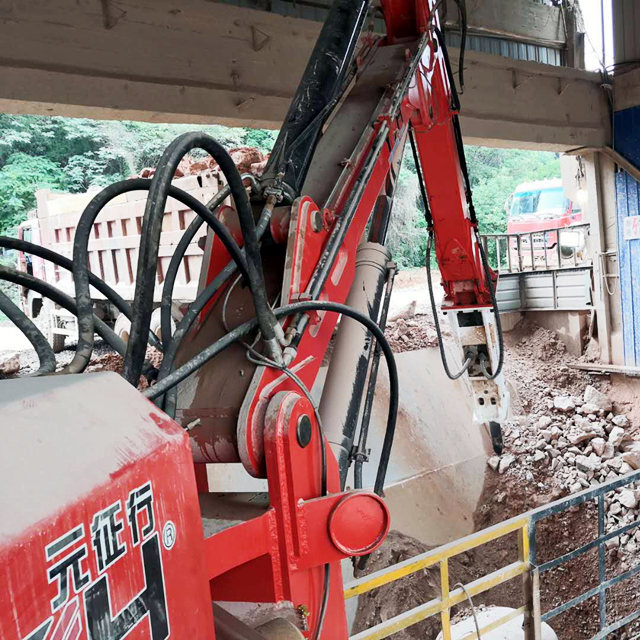
Pedestal systems sit in one spot and do one job really well. Less complexity, fewer failure points, more uptime.
Let me share what I see in real operations:
Jam clearing time: Usually under 15 minutes
Availability: Often above 95% when properly maintained
Precision: Hit the same breaking points every time
Operator training: Minimal – most learn the basics in a day
Mobile Units:
Jam clearing time: 30-45 minutes including positioning
Availability: Varies widely based on travel conditions
Precision: Depends entirely on operator skill
Operator training: Significant – takes weeks to become proficient
I'm not here to bash mobile units. They have their place.
If you've got multiple crushers spread across a large site, one mobile unit might make more sense than three pedestal systems. If your operation is temporary or you're doing contract work, mobility is essential.
The Flexibility Trade-off
Mobile units can handle unexpected situations better. Oversized material in an unusual location? No problem. Need to assist with maintenance work? Just drive over.
Pedestal systems are specialists. They do one thing exceptionally well, but they can't adapt to changing conditions without significant modification.
How Often Are You Breaking?
If you're clearing jams more than once a week, pedestal systems usually make economic sense. The time savings add up fast.
How Critical Is Uptime?
In operations where every hour of downtime costs thousands, pedestal systems typically win. They're just more reliable and faster to deploy.
What's Your Operator Situation?
Pedestal systems are more forgiving of operator skill differences. Mobile units require experienced operators to be truly effective.
For dedicated crusher applications with regular jam issues, pedestal systems almost always deliver better ROI. The precision, speed, and reliability advantages compound over time.
For operations with occasional issues across multiple locations, mobile units make more sense. The flexibility justifies the trade-offs in efficiency.
The Hybrid Approach
Some of our smartest customers use both. Pedestal systems at their primary crushers where jams are frequent and costly. Mobile units for everything else.
It's not either/or – it's about matching the right tool to the specific problem.
When customers ask me this question, I start with their specific situation:
How often do jams occur?
How much does downtime cost?
How many locations need service?
What's the skill level of operators?
The equipment choice should follow the operational reality, not the other way around.
Trying to figure out the right approach for your operation? Let's talk through your specific situation. Sometimes the best solution isn't what you'd expect.
Kevin Chen
Global Sales Manager
YZH Machinery Equipment Co., Ltd.
Helping customers choose the right rockbreaking solution since the early 2000s


