
Views: 0 Author: Kun Tang Publish Time: 2026-01-13 Origin: Jinan YZH Machinery Equipment Co., Ltd.
In the construction and mining industries, time is money, and the speed at which you can break rock or concrete determines your profit margin. Two technologies dominate this field: Hydraulic Breakers and Pneumatic Breakers.
While both serve the same fundamental purpose—fracturing material—they operate on entirely different physical principles. Choosing the wrong one can lead to lack of power on the job site or unnecessary fuel costs.
This guide breaks down the mechanics, performance, and economics of both systems to help you decide how to choose the best equipment for your specific project.
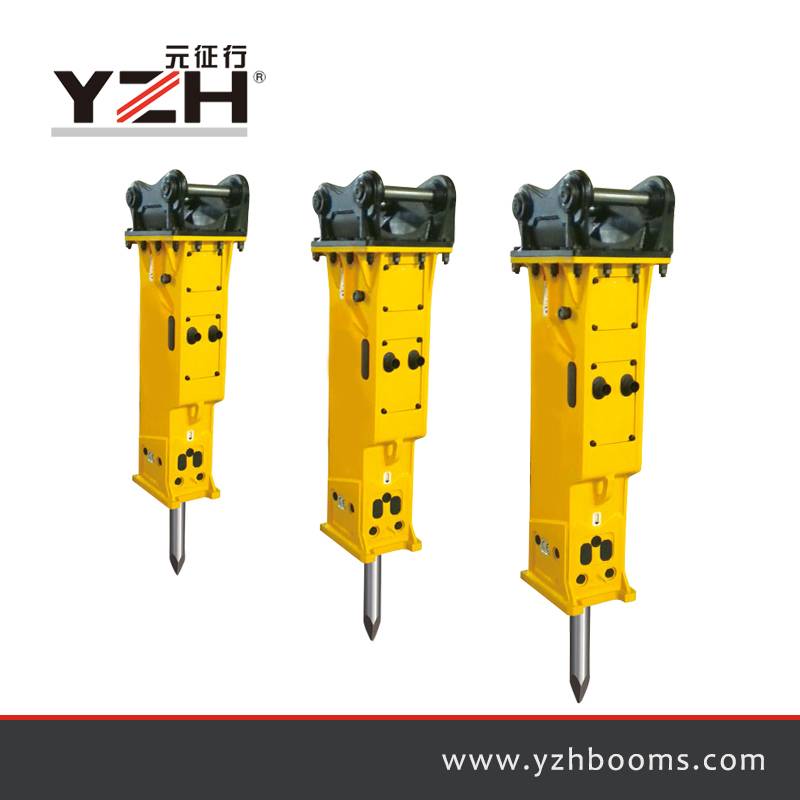
To understand the performance difference, we must first look at what drives the piston.
Hydraulic hammers operate using the hydraulic fluid supplied by a carrier (like an excavator or a pedestal boom).
The Mechanism: Hydraulic oil is an incompressible fluid. When pumped into the cylinder under high pressure, it drives a piston with immense force.
The Cycle: A valve system alternates the flow, causing the piston to strike the tool (chisel) and then retract. Because oil cannot be compressed, the energy transfer is almost instantaneous and highly efficient.
Pneumatic hammers are driven by compressed air supplied by an external compressor.
The Mechanism: Air enters the cylinder and expands, pushing the piston down.
The Limitation: Because air is a compressible gas, there is a slight "sponginess" or delay in energy transfer. Much of the engine's energy is lost as heat during the compression of the air before it even reaches the tool.
When comparing the two, Hydraulic Breakers generally outperform Pneumatic ones in heavy-duty applications.
Hydraulic: Offers a significantly higher power-to-weight ratio. A hydraulic breaker can deliver the same impact energy (Joules) as a pneumatic breaker that is twice its size. This makes them the standard for mining and heavy demolition.
Pneumatic: Generally delivers less impact energy per blow. They are effective for soft to medium materials but struggle with hard granite or reinforced concrete compared to hydraulic units.
Hydraulic: Modern hydraulic units are often "silenced" or box-enclosed. Since the system is closed-loop, there is no loud exhaust of air.
Pneumatic: Notorious for high noise levels. Every stroke releases a burst of high-pressure air (exhaust), creating a loud, percussive sound that often requires strict hearing protection zones.
Hydraulic: Requires clean oil and regular seal maintenance. However, because they are self-lubricating (via the hydraulic oil), internal wear is minimized if the oil is kept clean.
Pneumatic: Simpler design with fewer moving parts, but prone to "freezing" in cold weather due to moisture in the compressed air lines.
If your project involves heavy machinery, this is your only real option.
Mining & Quarrying: For breaking oversized boulders and primary crushing.
Large Scale Demolition: Breaking thick concrete foundations.
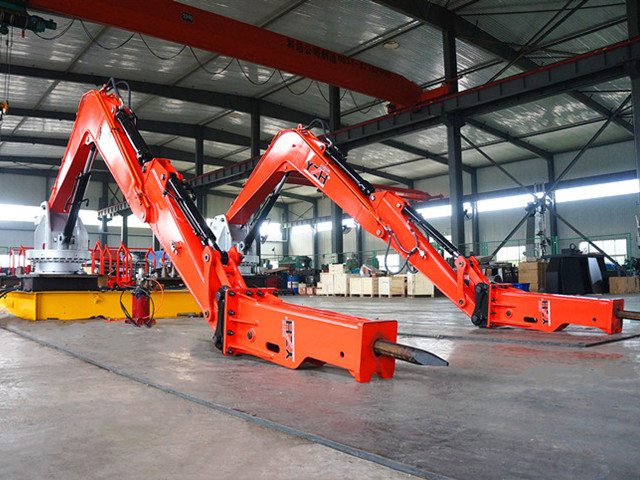
Excavator Attachments: Since excavators already have hydraulic systems, adding a Hydraulic Hammer is seamless and efficient.
Handheld Work: For light pavement breaking or working in tight spaces where a machine cannot fit.
Sites without Hydraulic Power: If you don't have an excavator but have a tow-behind air compressor.
Pneumatic: Cheaper to buy initially (especially handheld units). However, you must also factor in the cost of the air compressor and its fuel.
Hydraulic: Higher initial investment for the attachment. However, because they run off the carrier's engine, they are far more fuel-efficient.
Hydraulic systems typically transfer 80-90% of input energy to the tool. Pneumatic systems often achieve less than 50% efficiency due to thermal losses in compressing air. Over a year of operation, the fuel savings from using a Hydraulic Hammer can be substantial.
The verdict is clear: Scale dictates the choice.
For small, manual tasks, pneumatic tools remain useful. However, for industrial efficiency, mining, and heavy construction, Hydraulic Breakers are the superior choice. They offer higher impact energy, better fuel efficiency, and quieter operation.
If you are looking to maximize the productivity of your excavator or pedestal boom, investing in a high-performance hydraulic system is the smartest decision for your bottom line.
Ready to upgrade your breaking power?Explore our range of high-performance Hydraulic Hammers designed for durability and maximum impact energy.
Q1: Can a hydraulic breaker work underwater?
A: Yes, but it requires a specialized kit. Standard hydraulic breakers cannot be used underwater without modification, as water can enter the percussion chamber and damage the piston. You need an underwater compressed air kit to keep the chamber pressurized.
Q2: Which breaker lasts longer, hydraulic or pneumatic?
A: A hydraulic breaker generally has a longer service life if maintained correctly. The hydraulic oil lubricates and cools the internal components. Pneumatic tools often suffer from internal corrosion due to moisture in the compressed air.
Q3: Why are hydraulic breakers more powerful?
A: It comes down to physics. Hydraulic oil is incompressible, allowing for instant and massive pressure transfer (often 2000+ PSI). Air is compressible, acting like a spring that absorbs some of the energy before it hits the rock.
Q4: How do I match a hydraulic hammer to my excavator?
A: You must match the weight of the carrier and, more importantly, the hydraulic flow (LPM) and operating pressure. Using a hammer that requires more flow than your pump can provide will result in poor performance.


