Views: 0 Author: Kun Tang Publish Time: 2026-03-13 Origin: Jinan YZH Machinery Equipment Co., Ltd.
In the mining and aggregate industry, a blocked primary crusher is the enemy of profitability. When a bridged rock stops production, every minute counts. The question for site managers isn't if a blockage will happen, but how to clear it safely and quickly.
For over 20 years, Jinan YZH Machinery Equipment Co., Ltd. has helped quarries optimize their crushing circuits. A common dilemma we see is the choice between utilizing a Mobile Rock Breaker (an excavator with a hammer attachment) versus installing a dedicated Pedestal Rockbreaker Boom System.
While mobile units offer flexibility, stationary pedestal booms offer efficiency. This article breaks down the data, costs, and safety factors to help you make the right investment for your plant.
For Primary Crushing Stations: A Pedestal Boom System is the superior choice. It provides immediate response times (2–5 minutes), 24/7 availability, and keeps operators safe in a remote control room. It is the industry standard for high-volume jaw and gyratory crushers.
For Multi-Site Flexibility: A Mobile Rock Breaker is better suited if you need to service multiple locations or handle low-frequency blockages where speed is not critical.
Time is the critical metric. How long does the crusher stay idle?
When a blockage occurs, a mobile excavator must be driven to the crusher.
Response Time: 10–30 minutes (depending on where the excavator is parked).
Availability: Limited by operator shifts and other tasks the excavator might be performing.
Result: Significant production loss per incident.
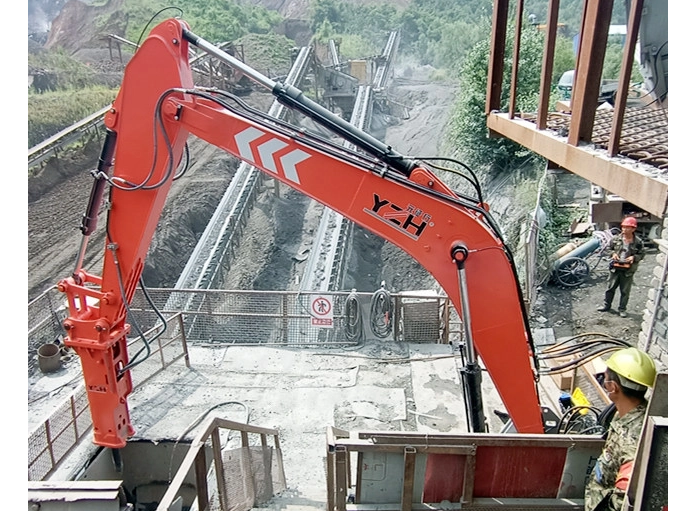
The Stationary Rock Breaker is permanently mounted at the crusher throat.
Response Time: Immediate (2–5 minutes). The operator simply engages the system via remote control.
Availability: 24/7. It is always ready, regardless of shift changes or other site activities.
Result: Continuous production flow.
Many buyers look at the initial purchase price, but the operating cost is where the real difference lies.
Mobile breakers burn diesel, wear out expensive tires/tracks, and require a dedicated carrier machine. Pedestal Boom Systems run on efficient electric-hydraulic power packs.
Cost Factor | Pedestal Boom System | Mobile Rock Breaker |
Energy Source | Electric (Low Cost) | Diesel (High Cost & Volatile) |
Maintenance | Minimal (Greasing, Seals) | High (Engine, Hydraulics, Undercarriage) |
Labor | Integrated into Crusher Operator role | Requires dedicated heavy equipment operator |
5-Year Est. Cost | 320,000–320,000–650,000 | 725,000–725,000–1,300,000 |
Data based on typical mining operations. Mobile costs include fuel, undercarriage wear, and dedicated labor.
The Takeaway: While a mobile excavator might seem like a "quick fix," a dedicated Pedestal Rockbreaker Boom System pays for itself through lower OpEx and higher uptime.
Modern mining regulations (ISO/CE) prioritize operator safety above all else.
Mobile Risks: An excavator operator must position the machine near the crusher edge. This exposes them to dust, noise, vibration, and the risk of fly-rock.
Pedestal Safety: YZH systems are designed for Remote Operation. The operator controls the boom from the safety of a climate-controlled cabin or a control room, far away from the danger zone. This aligns with our ISO 9001 quality and safety commitments.
Since 2002, YZH has developed specific series to match different crushing environments.
Reach: 4m – 8m
Power: 1,500 – 3,000 J Impact Energy
Best For: Clearing bridging in primary jaw crushers. The articulated arm design allows it to reach deep into the jaw chamber without damaging the liners.
Reach: 8m – 15m
Power: 3,000 – 6,000 J Impact Energy
Best For: Large-scale mining operations. These heavy-duty booms provide 360-degree rotation to cover the entire throat of massive gyratory crushers.
Reach: 5m – 15m (Linear Travel)
Best For: Raking and breaking oversized material on grizzly screens before it enters the crusher.
Explore the full range: Visit our Product List Page to see technical specifications for each series.
The decision comes down to your operational goals.
Choose a Mobile Breaker If: You have a low budget, very infrequent blockages (once a week), or need to use the excavator for digging duties elsewhere.
Choose a YZH Pedestal Boom System If: You run a primary crusher, safety is a priority, and you want to eliminate downtime costs permanently.
With over two decades of manufacturing experience and CE/ISO certification, YZH Machinery provides the reliability your mine needs. Don't let a stuck rock stop your profit.
Q1: Can a pedestal boom system be retrofitted to an existing crusher?
A: Yes. YZH designs Stationary Rock Breakers with modular mounting bases that can be installed on existing steel structures or concrete foundations at older plants.
Q2: What is the main cost advantage of a pedestal boom over an excavator?
A: The biggest saving is energy and maintenance. Electric power packs are significantly cheaper to run than diesel engines, and pedestal booms have no undercarriage (tracks/tires) to maintain.
Q3: How do I choose the right size boom for my crusher?
A: The boom needs to reach all corners of the crusher box and the breaker tool must be powerful enough to break your specific rock type. Check our YZH-B (Jaw) or YZH-G (Gyratory) series for specific reach capabilities.
Q4: Is remote control available for YZH systems?
A: Yes. All YZH systems can be equipped with radio remote control or integrated into your plant's central control room for maximum safety.