


YZH
YZH
Product Description
Industry information shows that fixed rockbreaker systems are mainly installed at:
Primary jaw or impact crusher inlets, where they perform secondary breaking and clear lodged boulders at the feed opening.
Fixed grizzlies, hoppers or chutes, where oversize or slabby rocks sit across the bars or opening and must be broken and raked through.
By designing the boom’s working envelope around these “trouble spots,” a Fixed Rockbreaker turns random blockages into routine, fast clearing operations.
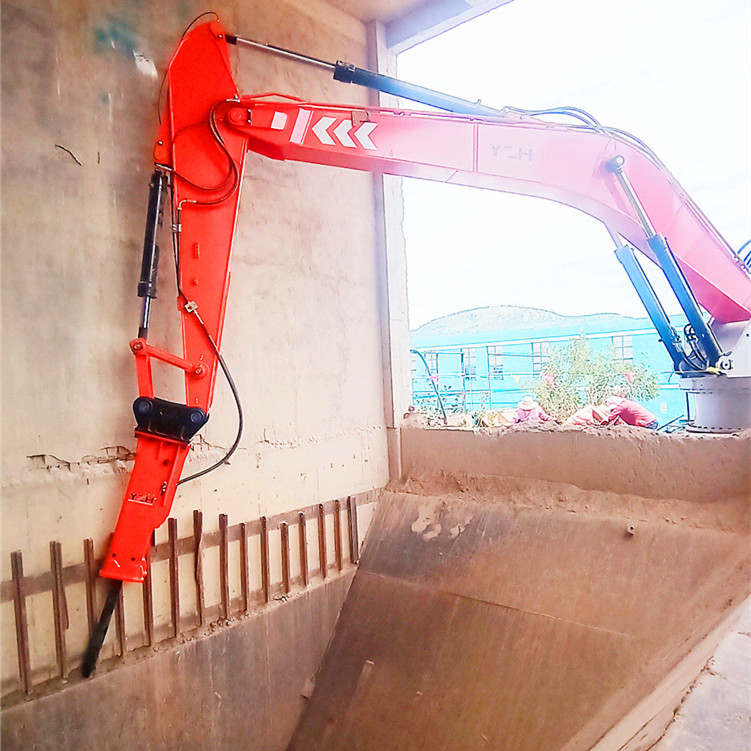
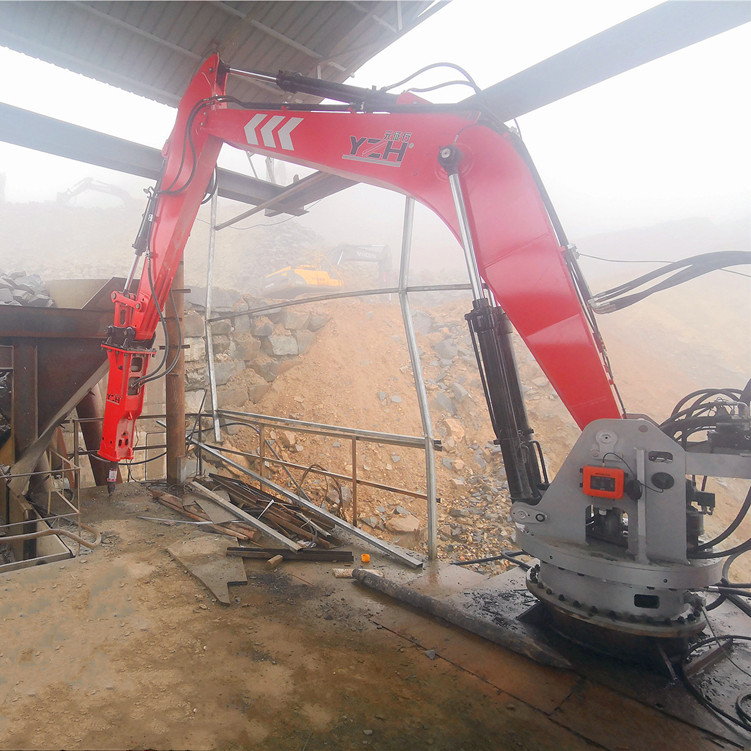
According to YZH and related technical descriptions, a Fixed Rockbreaker typically consists of four main assemblies:
Fixed base and slewing upper frame
The lower frame is securely anchored to a concrete or steel foundation; the upper frame uses a slewing bearing or swing console to provide horizontal rotation.
Lift boom and working arm
A lift boom and stick are built from high‑strength steel with reinforcement plates, large‑diameter pins and wear‑resistant bushings to withstand repeated impact and raking loads.
Hydraulic breaker (hammer)
A hydraulic breaker matched to the material and duty is mounted on the end of the working arm to break rock, ore, slag or concrete into passable sizes.
Hydraulic power unit and control system
A dedicated hydraulic power pack with electric motor, pump, tank, filters and cooling is designed for long‑duration operation.
Control options include local proportional valve joysticks or wired / wireless remote control, moving the operator out of the danger zone.
In operation, material enters the crusher or feed opening; when oversize blocks the opening, the operator swings the boom into position and uses the breaker to reduce the rock to a size that can pass, then rakes fragments into the flow.
Case studies and technical notes highlight strong performance in:
Quarries and aggregates: Clearing oversize at primary jaw or impact crushers and on grizzly bars feeding the plant.
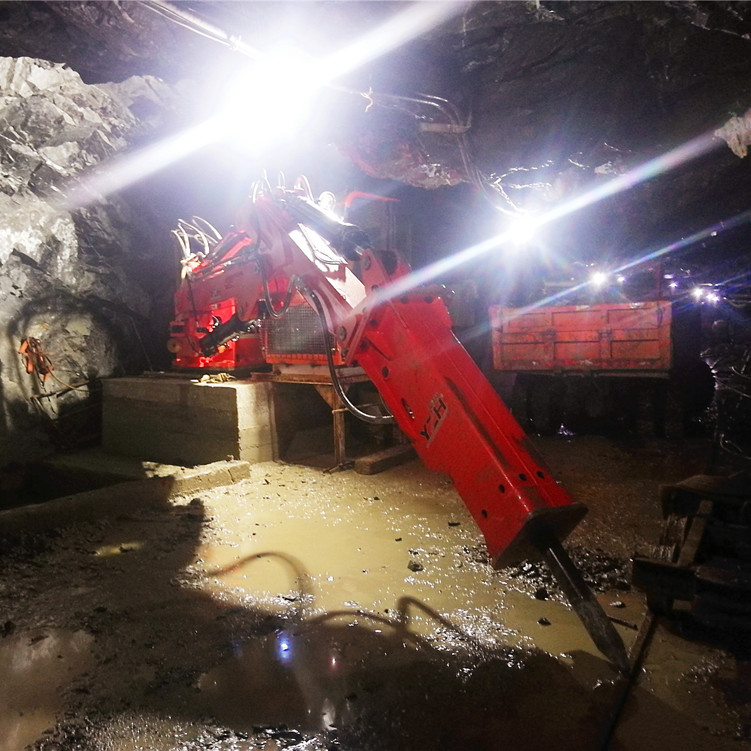
Metal mines and concentrators: Secondary breaking before ore enters crushers or storage bins to prevent chamber and bin hang‑ups.
Cement and raw material plants: Pre‑breaking large limestone or clinker to reduce impact loads on crushers and improve throughput.
Compared with excavators or manual methods, a Fixed Rockbreaker offers:
Instant availability and short response time, substantially reducing unplanned stoppages.
Lower operating cost, as the electric‑driven hydraulic unit uses far less energy than an equivalent diesel excavator.
Safer operation, with all work controlled from a console or remote rather than at the edge of hoppers or elevated platforms.
Representative models (such as BHA300, WHB710 and similar fixed hydraulic booms) illustrate typical working envelopes:
Max. horizontal reach around 4,800–9,000 mm to cover the crusher mouth and the front of the feed pile.
Max. vertical reach roughly 3,300–7,150 mm for working above tall piles or deep hoppers.
Minimum vertical radius and maximum working depth are balanced so the boom can work close to the inlet and higher up on the rock pile.
Rotation from 170° up to 360°, depending on configuration, to ensure full coverage of the breaking and raking zones.
By overlaying these envelopes on crusher and hopper drawings, engineers confirm that all potential blockage points fall within the boom’s working range.
YZH and similar suppliers stress that a Fixed Rockbreaker is not a one‑size‑fits‑all product but a site‑specific solution:
Boom length and breaker size are selected based on crusher type, feed opening dimensions, hopper height and material size distribution.
Base design and anchoring are adapted to the available foundations to ensure long‑term structural stability.
Control layout and safety interfaces are configured to match the plant’s automation and lock‑out procedures, from simple local controls to integration with the main control room.
If your crusher or grizzly is still frequently down due to oversize blockages and risky manual clearing, adding a Fixed Rockbreaker can turn that location into a dedicated secondary breaking and de‑blocking station.
Provide your crusher or hopper layout, material characteristics and capacity targets, and YZH can recommend a Fixed Rockbreaker model and boom envelope that matches your site conditions.


