Views: 0 Author: Kun Tang Publish Time: 2026-02-06 Origin: Jinan YZH Machinery Equipment Co., Ltd.
The image of the mining and construction industry is changing. The days of relying solely on brute force and manual labor are fading. Driven by the urgent need for improved safety, higher efficiency, and stricter environmental compliance, the humble hydraulic rock breaker is undergoing a technological revolution.
It is no longer enough for a machine to simply hit hard. The next generation of equipment must be smart, connected, and clean.
From AI-assisted positioning to fully electric Rock Breaker Booms Systems, this article explores the cutting-edge trends shaping the future of material processing.
The most significant shift in the industry is the integration of digital technology into mechanical hardware.
The operator is moving out of the cab and into the control room.
The Trend: Using 5G and low-latency video feeds, operators can now control rock breakers from miles away.
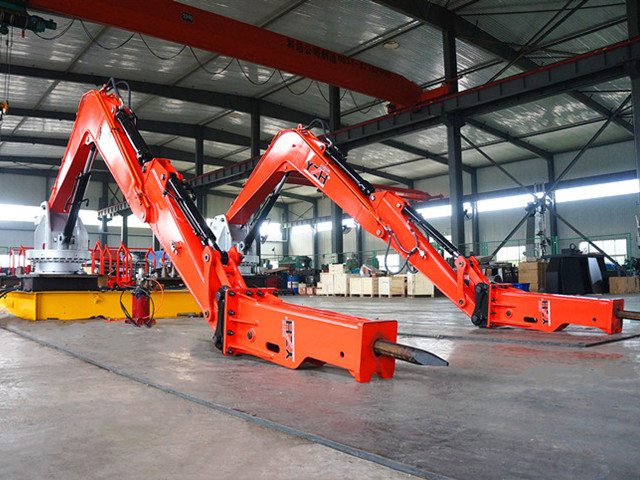
The Benefit: This removes personnel from hazardous environments (dust, vibration, noise) entirely. Stationary Rock Breaker Booms Systems are leading this trend, as they are ideal candidates for integration into central control room architectures.
The Innovation: Advanced systems are beginning to use LiDAR and 3D scanning to map the crusher box.
The Future: We are moving toward fully autonomous breaking, where the system identifies an oversized rock, calculates the optimal strike point, and executes the break without human intervention. This ensures consistent productivity regardless of operator skill level.
The Upgrade: Manufacturers are utilizing new high-strength alloys and heat-treatment processes to create lighter yet stronger breaker bodies. This improves the power-to-weight ratio, allowing smaller booms to deliver heavier impacts.
Environmental Social Governance (ESG) is now a top priority for mining companies and urban contractors.
The Shift: While mobile excavators struggle with battery life, stationary pedestal booms have always had the advantage of being electrically powered.
The Advantage: As the industry strives for "Net Zero" carbon emissions, the electric Rock Breaker Booms System is becoming the preferred choice over diesel-run mobile breakers for primary crushing stations. They offer zero exhaust emissions and significantly lower energy costs.
The Demand: Urban expansion means construction often happens next to hospitals or residential zones.
The Tech: Future breakers feature "silenced" housing designs and internal buffer systems that dampen noise and prevent vibration from traveling into the ground/structure.
The global market for hydraulic breakers is projected to grow, driven by infrastructure development in emerging economies and the retrofitting of aging mines in developed nations.
Infrastructure Boom: Massive urbanization projects in Asia and Africa require efficient demolition and excavation tools.
Retrofitting: Old quarries are upgrading manual clearing methods to automated rockbreaker applications to meet modern safety standards.
Skill Gap: As machines become more complex, there is a shortage of technicians skilled in both hydraulics and electronics.
Solution: This is driving manufacturers to design "maintenance-free" features, such as automatic lubrication and self-diagnosing systems that alert the user before a failure occurs.
The future of the hydraulic rock breaker is Connected, Electric, and Autonomous.
While the core physics of breaking rock remains the same, the method of delivery is evolving. The industry is moving away from reactive, manual solutions toward proactive, integrated systems.
For mine managers and site directors, investing in a modern Rock Breaker Booms System is not just a purchase—it is a step toward a safer, cleaner, and more automated future.
Is your operation ready for the future?Explore our advanced breaking solutions designed to meet the demands of tomorrow's industry.
Q1: Will AI replace rock breaker operators?
A: Not entirely, but it will change their role. Operators will become "system supervisors," managing multiple machines from a safe distance, intervening only when the automated system encounters a complex problem.
Q2: Why are stationary booms considered "greener" than mobile breakers?
A: Stationary booms are typically powered by electric hydraulic power packs. This eliminates diesel exhaust emissions and reduces the carbon footprint of the operation compared to running a diesel engine excavator all day.
Q3: Can older rock breaker systems be upgraded with remote control?
A: Many stationary pedestal booms can be retrofitted with remote control kits and camera systems. However, full automation usually requires modern sensors and hydraulic valves found in newer models.
Q4: What is the benefit of "Tele-operation"?
A: Tele-operation allows an expert operator to control a machine in a dangerous or distant location (like an underground mine) from the comfort of a surface office. This improves quality of life for the worker and reduces travel time underground.