Views: 0 Author: Kun Tang Publish Time: 2026-02-24 Origin: Jinan YZH Machinery Equipment Co., Ltd.
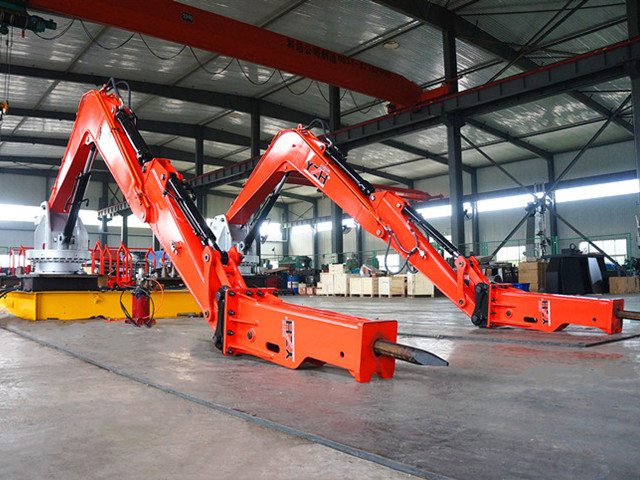
A hydraulic rock breaker is one of the most punishing attachments in the heavy equipment arsenal. It is designed to destroy, but it is not indestructible.
The difference between a Rock Breaker Booms System that lasts for 10 years and one that fails in 10 months often comes down to one factor: The Operator.
Improper technique doesn't just lower productivity; it causes catastrophic failures—snapped tools, overheated hydraulics, and cracked boom structures. This guide outlines the operational best practices that every site manager and operator needs to know to maximize efficiency and extend equipment life.
You wouldn't drive a car without checking the fuel; don't start a breaker without checking the vitals.
Before the hydraulic pump is engaged, perform a walk-around:
Retainer Pins: Ensure the pins holding the tool (chisel) are secure. If these fall out, the tool becomes a projectile.
Hydraulic Hoses: Look for "weeping" leaks or abrasions. A burst hose under pressure is a major safety hazard.
Mounting Bolts: The vibration of breaking loosens bolts. Check the adapter plate bolts daily.
The Golden Rule: A dry tool bushing is a dead tool bushing.
The Check: Verify that the automatic lubrication system is full and functioning. If greasing manually, ensure the tool is pressed up against the piston (not hanging down) to ensure grease reaches the contact surface.
The Best Practice: In cold climates, do not operate at full power immediately. Cycle the boom cylinder to warm the hydraulic oil. Cold oil can damage seals and diaphragms.
Breaking rock is about physics, not just brute force.
The Technique: Always position the tool at a 90-degree angle to the rock surface.
Why? If you strike at an angle, the piston hits the side of the tool instead of the top. This "side-loading" sends stress waves into the breaker body and snaps the tool.
The Mistake: Firing the breaker when the tool is not firmly pressed against the rock, or continuing to fire after the rock has broken.
The Consequence: The piston strikes nothing but the retainer pins. This shockwave reflects back into the machine, destroying tie rods and seals.
The Fix: Always apply down-pressure before firing. Stop firing the instant the rock fractures.
The Technique: Never hammer in the same spot for more than 15–30 seconds.
Why? Drilling in one spot creates a "dust cushion" that absorbs the impact energy. It also generates extreme heat, which softens the steel tool (mushrooming).
The Fix: If it doesn't break in 15 seconds, stop and reposition the tool to a weak point (like a crack or edge).
The Mistake: Using the tool to lever rocks around the crusher box.
The Reality: Hydraulic tools are hardened for impact, making them brittle against bending. Prying will snap the tool instantly. Use the boom arm or a grapple for moving material.
Preventative maintenance is cheaper than reactive repair.
Frequency: For manual systems, grease every 2 hours of continuous operation.
Product: Use high-temperature "chisel paste" (often containing molybdenum/copper), not standard bearing grease. Standard grease melts and runs out under the heat of impact.
The Role: The nitrogen chamber acts as a shock absorber.
The Sign: If the hoses are "jumping" violently, the gas pressure may be low.
The Action: Check the backhead pressure every 500 hours or as recommended in your Rock Breaker Booms System manual.
Operational excellence is the key to profitability.
By following these best practices—avoiding blank firing, maintaining the 90-degree angle, and ensuring proper lubrication—you transform your Rock Breaker Booms System from a maintenance burden into a reliable production asset.
Looking for a system built for durability?Explore our heavy-duty breaking solutions, engineered to withstand the toughest mining environments.
Q1: Why does my rock breaker tool keep breaking?
A: The most common causes are prying (using the tool as a lever), blank firing (not enough down-pressure), or excessive wear in the bushings which allows the tool to wobble and be struck at an angle.
Q2: How much down-pressure should I apply?
A: Apply enough pressure to lift the front of the carrier (or stabilize the boom) slightly. This ensures the tool is fully seated against the piston inside the cylinder, allowing for maximum energy transfer.
Q3: Can I use standard grease on my rock breaker?
A: No. You must use specific "Chisel Paste" or high-temp moly grease. Standard grease will melt at the high temperatures generated by the friction of the tool, leaving the steel unprotected.
Q4: What is the "15-Second Rule"?
A: Do not strike the same spot for more than 15 seconds. If the rock doesn't break, the energy is converting to heat (damaging the tool) rather than fracture. Reposition the tool to a new spot.