
Views: 0 Author: Kun Tang Publish Time: 2025-12-19 Origin: Jinan YZH Machinery Equipment Co., Ltd.
The global rock crushing industry is standing at a pivotal crossroads. Gone are the days when "bigger and stronger" were the only metrics that mattered. Today, the industry is being reshaped by a convergence of digital transformation, strict environmental regulations, and shifting global infrastructure demands.
From the quarries of Europe to the mines of South America, the mandate is clear: operations must become smarter, safer, and more sustainable. This article explores the trajectory of the rock crusher market and what businesses must do to stay competitive in this evolving landscape.
The appetite for crushed stone, sand, and gravel remains insatiable, but the source of this demand is shifting.
Rapid urbanization in developing economies drives the demand for primary aggregates. However, in developed nations, the focus has shifted toward infrastructure renewal—repairing bridges, roads, and tunnels—which requires precise, high-quality aggregate specifications.
Perhaps the most significant shift is the booming market for Construction and Demolition (C&D) waste recycling. Contractors are no longer just buying virgin aggregate; they are processing on-site waste. This creates a demand for mobile crushers and versatile breaking equipment capable of handling reinforced concrete and asphalt.
The future of crushing is digital. The integration of IoT (Internet of Things) and AI is transforming how we process rock.
Safety is the primary driver for automation. The industry is moving personnel out of hazardous zones and into control rooms.
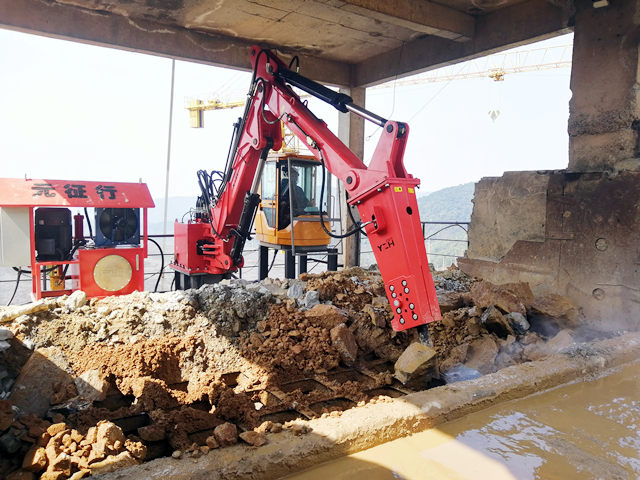
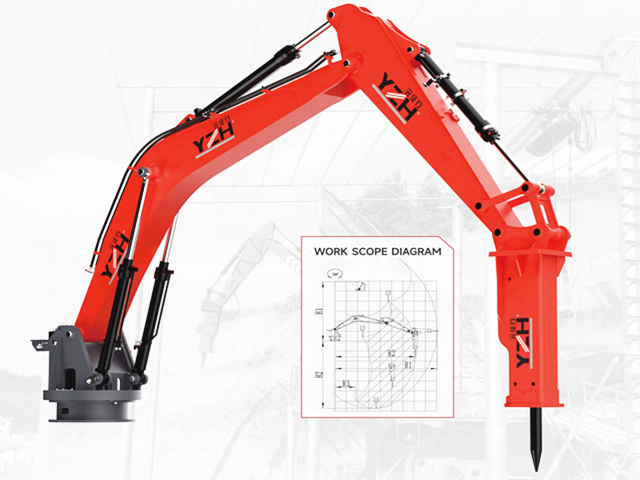
This is where advanced auxiliary equipment plays a vital role. In the past, clearing a crusher blockage meant dangerous manual labor. Today, automated and remote-controlled Pedestal Boom Systems are the standard. These systems allow operators to manipulate hydraulic hammers remotely to clear jams, ensuring that the "human-in-the-loop" is safe and efficient.
Smart sensors now monitor vibration, temperature, and wear in real-time. Instead of waiting for a breakdown, operators receive alerts before a bearing fails. This shift from reactive to predictive maintenance drastically reduces downtime and operational costs.
"Green Mining" is no longer a buzzword; it is a license to operate.
Urban expansion means quarries are often located closer to residential areas. Modern crushers are being designed with encapsulated housings and advanced dust suppression systems to minimize environmental impact.
The shift from diesel-hydraulic to electric-drive systems is accelerating. Electric crushers and breaker booms offer higher efficiency, lower carbon footprints, and reduced noise levels. For underground mining, where ventilation costs are high, electric equipment is becoming the only viable option.
The future of the rock crusher industry belongs to those who adapt. The successful operation of tomorrow will prioritize:
Versatility: Equipment that can handle both virgin rock and recycled materials.
Connectivity: Machines that "talk" to each other to optimize flow.
Safety: Utilizing tools like Pedestal Boom Systems to remove humans from danger zones.
As the industry evolves, choosing the right technology partners—suppliers who understand both the mechanics of crushing and the nuances of modern efficiency—will be the key to long-term profitability.
Prepare your operation for the future. Discover how our advanced Pedestal Boom Systems can integrate into your smart mining or recycling workflow.
Q1: How is AI affecting the rock crushing industry?
A: AI is being used to optimize the "closed side setting" of crushers automatically based on the material feed, ensuring consistent product size and maximizing throughput without human intervention.
Q2: Why is the industry moving toward electric crushers?
A: Electric crushers have lower operating costs (electricity is generally cheaper than diesel), require less maintenance (fewer moving engine parts), and produce zero emissions at the point of use, which is critical for environmental compliance.
Q3: What role do pedestal booms play in modern automated mines?
A: They are the "safety hands" of the crusher. In an automated mine, if a sensor detects a blockage, a remote operator can use the pedestal boom to clear it via camera feed, ensuring the automated process resumes quickly without risking human safety.
Q4: Is concrete recycling really growing?
A: Yes, significantly. As natural sand and gravel reserves deplete and landfill costs rise, recycling concrete into reusable aggregate is becoming a major revenue stream for construction companies.


