
Views: 0 Author: Kun Tang Publish Time: 2026-01-12 Origin: Jinan YZH Machinery Equipment Co., Ltd.
Granite is one of the most abrasive and durable materials on Earth. Widely used in construction and mining, its high density and structural integrity make it a premium resource, but also a nightmare to process.
For quarry operators and mine managers, the challenge is simple: How much force is actually needed to break it?
Underestimating the required energy leads to equipment fatigue and low production rates. Overestimating it results in unnecessary fuel consumption and excessive "fines" (waste dust). This guide explains the physics behind the process and provides a method to calculate the optimal impact energy for your operation.
Before running the numbers, you must understand the material. The "breakability" of rock is determined by three key factors:
Compressive Strength (MPa): This is the resistance of the rock to breaking under compression. Granite typically ranges from 100 MPa to 250 MPa (14,500 – 36,000 psi).
Mohs Hardness: Granite usually sits between 6 and 7 on the Mohs scale, meaning it is highly abrasive to steel tools.
Tenacity (Toughness): Unlike brittle limestone, granite has a crystalline structure that absorbs energy. It requires a "sharp," high-velocity blow to initiate a fracture.
The Rule of Thumb: The higher the MPa, the higher the impact energy (Joules) required per blow to initiate a crack.
While exact physics calculations depend on the specific mineral composition, industry experts use a correlation between Rock Volume, Hardness, and Breaker Energy.
The energy ($E$) required to break a rock is proportional to its volume ($V$) and its specific fracture energy ($W$).
E≈V×K×σE≈V×K×σ
$V$ = Volume of the rock (m³)
$K$ = Resistance coefficient (based on rock integrity/cracks)
$\sigma$ = Compressive Strength (MPa)
Let’s calculate the requirements for a typical oversized boulder in a quarry.
Scenario: You need to break a 1 cubic meter (1m³) block of solid, un-cracked Granite.
Rock Hardness: 200 MPa (High strength).
Target: You want to split this in minimal blows.
Step 1: Determine the Impact ClassFor hard rock (>150 MPa), you generally need a breaker capable of delivering high impact energy density.
Industry Standard: To effectively shatter 200 MPa granite, you need approximately 3,000 to 5,000 Joules per blow to initiate a deep fracture.
Step 2: Adjust for Rock Condition (The "K" Factor)
Solid Rock: Requires 100% energy.
Fissured/Cracked Rock: Requires ~60% energy.
Step 3: Select the BreakerIf your calculation shows you need consistent 4,000+ Joule blows, a small excavator attachment will fail. You need a heavy-duty system.
Once you have calculated the difficulty of the rock, you must match it to the machine.
Using a breaker with insufficient energy on granite causes "blank firing" damage—the piston hits the tool, but the tool doesn't penetrate the rock. The shockwave reflects back into the breaker, destroying seals and tie rods.
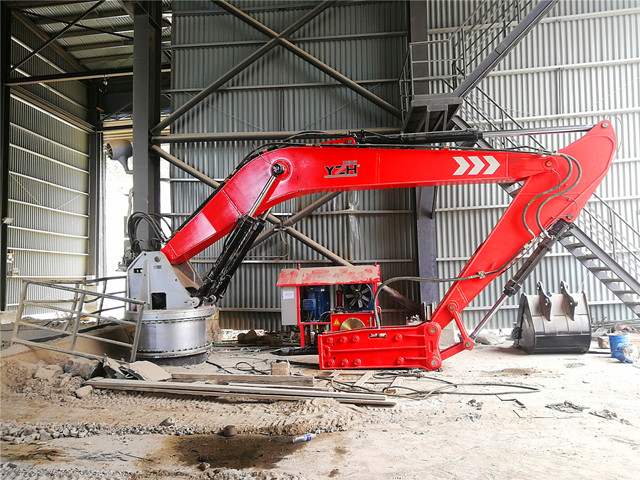
For stationary applications (like clearing a primary crusher), the most efficient solution is a Pedestal Boom System.
Consistent Positioning: Unlike a mobile excavator, a pedestal boom can position the tool at the perfect 90-degree angle. This ensures 100% of the calculated impact energy is transferred to the rock, not lost in glancing blows.
Heavy Duty Class: YZH Pedestal Booms are designed to host heavy-class hydraulic hammers capable of delivering the high Joule output needed for 200+ MPa granite.
Real-world conditions often differ from the lab. Adjust your energy requirements based on:
Density: Granite is dense (~2.7 g/cm³). Denser rocks absorb more wave energy, requiring higher impact velocity.
Abrasiveness: High silica content in granite wears down the tool tip. A blunt tool requires 30% more energy to break the same rock than a sharp tool.
Temperature: In extreme cold, steel becomes brittle. While the required energy to break the rock remains similar, the equipment must be warmed up to deliver that energy safely.
Calculating the required impact energy for granite is not just a math exercise; it is a cost-saving strategy.
For hard granite (200 MPa+), "guessing" leads to broken equipment. By understanding the relationship between Compressive Strength and Impact Joules, you can select the right tool for the job.
If your operation handles high-hardness granite at the primary crusher, a standard mobile breaker may not suffice. Investing in a correctly sized Pedestal Boom System ensures you always have the necessary power on tap to keep your production line moving.
Q1: How does granite compare to limestone in terms of required breaking energy?
A: Granite is significantly harder. Limestone typically has a compressive strength of 30-80 MPa, while granite ranges from 100-250 MPa. You typically need a breaker with 2x to 3x the impact energy for granite compared to limestone of the same size.
Q2: Can I use a larger breaker to break granite faster?
A: Yes, but with caution. Using a breaker that is too powerful for the rock size can cause "flying rock" hazards and excessive vibration damage to the carrier or boom. The goal is to match the energy to the rock's resistance.
Q3: How do I know if my current breaker has enough energy?
A: Watch the tool. If the tool penetrates the rock within 3-5 seconds of operation, the energy is sufficient. If the tool overheats and the rock only creates white dust without cracking after 10 seconds, your impact energy is too low.
Q4: Does the shape of the tool (chisel) affect the energy calculation?
A: Yes. For granite (hard and abrasive), a blunt or wedge tool is often preferred over a moil point. The wedge directs the energy to split the natural crystalline structure, effectively lowering the total energy required to create a fracture.


