
Views: 0 Author: Kun Tang Publish Time: 2025-12-25 Origin: Jinan YZH Machinery Equipment Co., Ltd.
For decades, the image of the rock crushing industry has been one of dust clouds, deafening noise, and high fuel consumption. However, the landscape is changing rapidly. With tightening environmental regulations and a global push toward "Green Mining," sustainability is no longer an option—it is a necessity.
Modern crushing operations are adopting advanced technologies to minimize their ecological footprint without sacrificing production. From wet processing methods to electric-hydraulic auxiliary equipment, this guide explores the innovations making the crushing industry cleaner, quieter, and more energy-efficient.
One of the most effective ways to combat airborne pollution is by addressing it at the source. Wet crushing is a method where water is introduced into the crushing circuit.
Unlike dry crushing, which relies on air filtration, wet crushing uses water sprays at critical transfer points and inside the crushing chamber.
Dust Suppression: Water binds with fine particles, preventing them from becoming airborne.
Washing Action: It simultaneously washes the aggregate, removing clay and impurities, which results in a higher quality end-product (often required for high-grade concrete).
Wet processing is particularly effective in processing sand and gravel where the material already has a high moisture content. It eliminates the need for complex dust collection baghouses, though it does require a water management system (settling ponds or filter presses) to recycle the water.
Urban sprawl means quarries are operating closer to communities than ever before. Controlling nuisances is critical for maintaining your "social license to operate."
Crushers are naturally loud, but technology can dampen the impact:
Encapsulation: Modern plants use insulated enclosures that can reduce noise levels by 15–20 decibels.
Rubber Linings: Replacing steel chutes with rubber-lined chutes significantly reduces the high-pitched clang of falling rock.
Beyond wet crushing, "Dry Fog" systems are gaining popularity. These systems use ultrasonic nozzles to create water droplets so small (1–10 microns) that they attach to dust particles and bring them down without wetting the material significantly. This is crucial for processes that require dry final products.
Reducing energy consumption is the dual-win of environmental tech: it lowers carbon emissions and cuts operational costs.
The industry is moving away from diesel engines toward electric drives. Electric motors are more efficient (90%+ efficiency vs. 35-40% for diesel) and offer instant torque.
A major source of wasted energy and emissions in quarries is the use of mobile diesel excavators to clear crusher blockages. These machines idle for hours, burning fuel unnecessarily.
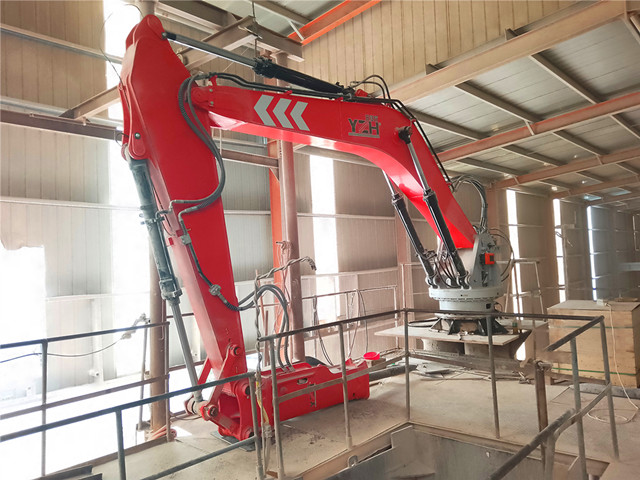
The sustainable solution is the installation of Pedestal Boom Systems.
Electric-Hydraulic Efficiency: Unlike diesel excavators, YZH Pedestal Booms are typically powered by electric-hydraulic power packs. They consume energy only when in use and produce zero emissions at the point of operation.
Precision Power: They deliver targeted force to break oversized rocks, preventing the energy spikes associated with crushers trying to process materials beyond their capacity.

The future of the rock crushing industry is defined by sustainability. Environmental technology is not just about compliance; it is about efficiency.
By adopting wet crushing for dust control, implementing noise suppression for community relations, and upgrading to electric pedestal boom systems for energy savings, operators can build a mine that is profitable today and sustainable for tomorrow.
Ready to lower your carbon footprint? Replace your diesel mobile equipment with our energy-efficient Pedestal Boom Systems and drive your operation toward a greener future.
Q1: What is the difference between wet and dry dust suppression?
A: Wet suppression uses water sprays to wet the material and prevent dust from rising. Dry suppression (or Dry Fog) uses microscopic water droplets to capture airborne dust without significantly wetting the material, which is better for screening fine products.
Q2: How do Pedestal Boom Systems contribute to environmental protection?
A: They replace diesel-powered excavators. Since Pedestal Booms are usually powered by electric motors, they eliminate exhaust emissions at the crusher site and significantly reduce noise and fuel consumption.
Q3: Can noise control measures affect crusher performance?
A: Generally, no. In fact, rubber linings (used for noise reduction) often last longer than steel liners in abrasive applications, reducing maintenance downtime.
Q4: Is it expensive to upgrade to eco-friendly crushing tech?
A: While the initial investment (e.g., for electric infrastructure or water treatment) can be higher, the long-term savings in fuel, fines for non-compliance, and maintenance often result in a lower Total Cost of Ownership (TCO).


