
Views: 0 Author: Kun Tang Publish Time: 2025-12-29 Origin: Jinan YZH Machinery Equipment Co., Ltd.
In the aggregate and mining sectors, the difference between a profitable operation and a money pit often comes down to one decision: equipment selection. Choosing the wrong crusher for your specific application can lead to rapid wear, poor product shape, and skyrocketing energy costs.
A successful crushing plant isn't just a collection of machines; it's a carefully balanced system. Whether you are processing abrasive granite or soft limestone, understanding how to match the machine to the material is critical. This guide breaks down the science of crusher selection and configuration to help you build a production line that delivers.
Before looking at machine specs, you must look at the geology. The physical characteristics of the raw material dictate the type of crusher required.
Hard & Abrasive (e.g., Granite, Basalt, River Pebbles): These materials require compression crushing. Using an impact crusher here will result in excessive wear costs.
Recommended: Jaw Crushers (Primary) and Cone Crushers (Secondary).
Soft & Non-Abrasive (e.g., Limestone, Coal, Gypsum): These materials are easier to break and often benefit from impact crushing to create a good shape.
Recommended: Impact Crushers or Hammer Crushers.
High moisture content can cause clogging in the crushing chamber. If your material is sticky or wet, standard crushers may struggle without specific modifications or pre-screening.
"Bigger is better" is not always true. An oversized crusher running empty wastes energy, while an undersized crusher creates a bottleneck.
You must determine your target production rate. However, you should size your primary crusher to handle 10–15% more than your target average to account for fluctuations in feed rate.
Reduction Ratio: This is the ratio of the feed size to the product size.
The Rule: A single crusher rarely achieves a high reduction ratio efficiently. A typical setup involves a primary crusher (taking 1000mm rock down to 200mm) followed by a secondary crusher (taking 200mm down to 40mm).
Understanding the mechanics of each crusher type is essential for making the right choice.
Pros: Handles the hardest rocks; simple structure; low maintenance.
Cons: Product shape can be flaky (needs secondary crushing).
Best For: Primary crushing of hard, abrasive materials.
Pros: Excellent for hard rock; low wear cost per ton; high throughput.
Cons: Higher initial cost; complex maintenance.
Best For: Secondary or tertiary crushing of granite, basalt, and iron ore.
Pros: Produces excellent cubic shape (high quality); high reduction ratio.
Cons: High wear rate on blow bars if used on abrasive rock.
Best For: Soft to medium-hard rock or recycling applications.
A crusher does not work in isolation. It is part of a circuit involving feeders, screens, and conveyors. A holistic configuration ensures smooth flow.
Vibrating Feeder: Regulates the flow of material.
Primary Crusher: Breaks the run-of-mine (ROM) rock.
Vibrating Screen: Separates sized material from oversized material.
No matter how well you configure your plant, oversized rocks and blockages will happen. If a rock bridges the jaw crusher, production stops.
The Old Way: Stopping the plant and using dangerous manual methods to clear the jam.
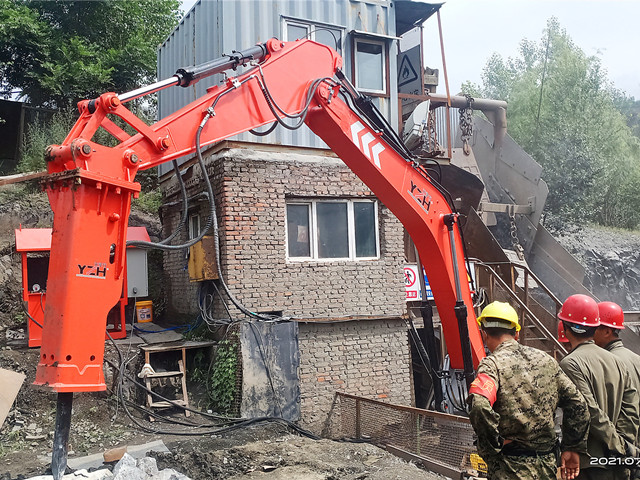
The Professional Configuration: Installing a Pedestal Boom System at the primary station.
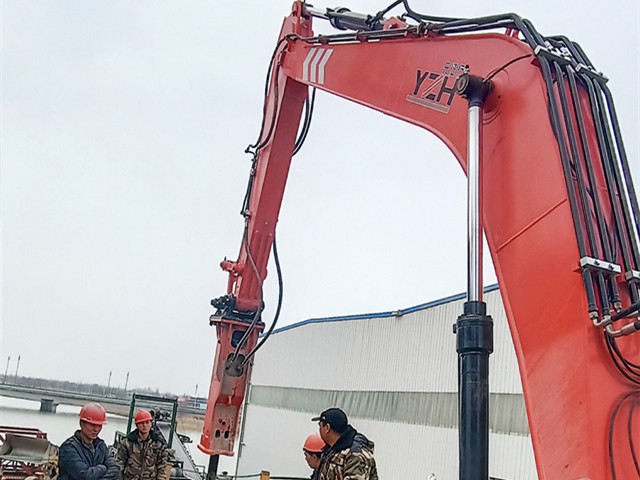
A Pedestal Boom is a stationary hydraulic arm equipped with a breaker. It is the "insurance policy" for your plant. By integrating this system into your initial configuration, you ensure that blockages can be cleared instantly and remotely, maintaining the TPH you calculated in step 2.
Selecting the right rock crusher is a balance of Material, Capacity, and Budget.
Process hard rock? Choose Jaw + Cone.
Process soft rock? Choose Impact.
Want consistent uptime? Configure with a Pedestal Boom.
By analyzing your specific needs and consulting with experts, you can configure a production line that is not only efficient but also resilient against downtime.
Optimizing your plant configuration? Don't forget the safety equipment. Explore our Pedestal Boom Systems to ensure your new crushing line runs without interruption.
Q1: Can I use an impact crusher for granite?
A: It is possible, but not recommended for the primary stage. Granite is highly abrasive and will wear out the impactor's blow bars very quickly, leading to high operating costs. A Jaw or Cone crusher is better suited for granite.
Q2: How do I determine the right size for my crusher?
A: You need to consider the maximum size of the raw stone (Max Feed Size) and the required hourly output (TPH). The crusher's feed opening must be larger than your largest rock, and its capacity should slightly exceed your production target.
Q3: Why is a Pedestal Boom considered part of the "Configuration"?
A: Because blockages are a predictable part of crushing. Including a Pedestal Boom in the initial design ensures the plant has a dedicated mechanism to handle these events without stopping production, which is vital for calculating overall plant efficiency (OEE).
Q4: What is the difference between a primary and secondary crusher?
A: A primary crusher (like a Jaw) is designed to take large, blasted rock and break it down to a manageable size (e.g., 6-8 inches). A secondary crusher (like a Cone) takes that material and crushes it down to the final marketable product size (e.g., 1 inch or 1/2 inch).


