Views: 0 Author: Kun Tang Publish Time: 2026-03-23 Origin: Jinan YZH Machinery Equipment Co., Ltd.
In the rugged environments of open-pit mines and aggregate quarries, the primary crusher is the bottleneck. If rock doesn't flow through the primary station, the secondary and tertiary circuits starve, and production targets are missed.
For over 20 years, Jinan YZH Machinery Equipment Co., Ltd. has understood that a reliable crushing circuit requires more than just a crusher—it requires a dedicated safety valve. That safety valve is the Pedestal Rockbreaker Boom System.
Whether you are processing soft limestone or abrasive iron ore, selecting the right boom configuration for your specific crusher type (Jaw, Gyratory, or Grizzly) is critical. This guide breaks down the engineering requirements for each application.
What is the right pedestal boom for my mine?
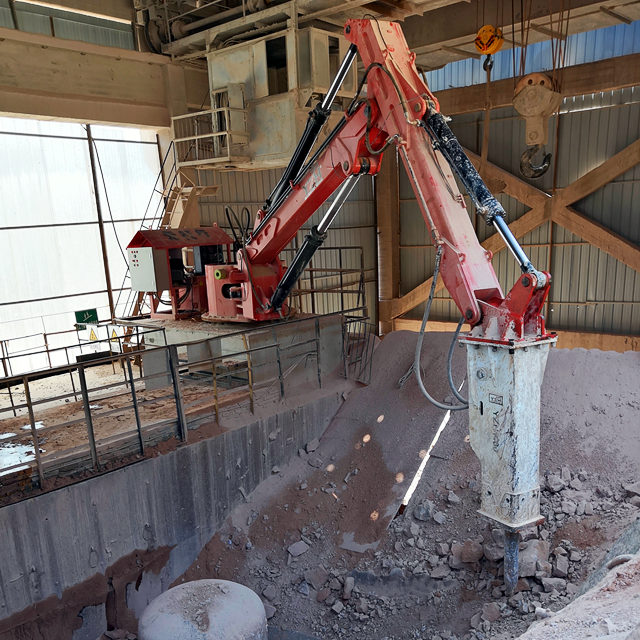
For Jaw Crushers: You need an articulated boom with 4–8 meters of reach and a 1,500–3,000 Joule hammer. It must be agile enough to poke corners and rake material.
For Gyratory Crushers: You need a heavy-duty boom with 8–15 meters of reach and a 3,000–6,000 Joule hammer. It requires 360-degree rotation to clear bridges across the entire bowl.
For Grizzly Bars: You need a linear travel system that can move along the width of the grizzly to scalp oversized rocks before they enter the feeder.
The jaw crusher is the workhorse of the quarry. Blockages here are typically caused by "bridging" (two rocks locking together) or oversized feed material.
The boom must reach deep into the jaw chamber to break the "keystone" rock causing the bridge, but it must also be able to retract fully to allow dump trucks to unload safely.
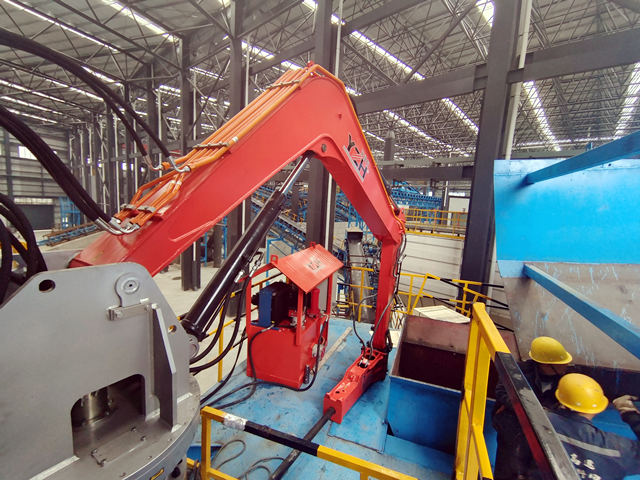
Our YZH-B Series is designed with a compact, articulated arm specifically for these constraints.
Reach: 4m – 8m (Ideal for 30" x 42" to 60" x 48" jaws).
Hammer Power: 1,500J – 3,000J.
Key Feature: The "knuckle" design allows the tool to manipulate rock at precise angles, effectively "poking" the blockage loose without damaging the expensive manganese liners.
Gyratory crushers are the giants of the mining world, often handling thousands of tons per hour. A blockage here is a major logistical crisis.
Gyratory crushers have a wide intake and a central "spider" arm that can create complex jams. The rock breaker must be massive enough to reach across the spider arm to the far side of the bowl.
The YZH-G Series represents our heavy-duty engineering.
Reach: 8m – 15m (Massive reach for deep cavities).
Hammer Power: 3,000J – 6,000J (Required for hard ores like Copper and Iron).
Key Feature: 360-degree rotation on a reinforced slewing ring. This allows the operator to position the hammer anywhere in the crusher throat or even service the maintenance bay next to the crusher.
Before the rock even hits the crusher, it passes over the Grizzly bars.
Oversized rocks (overs) sit on top of the bars, blocking the flow of smaller material (unders). A standard rotating boom often struggles to reach the corners of a wide grizzly screen.
We utilize a Linear Rail System for these applications.
Travel: 5m – 15m (The boom base slides along a track).
Hammer Power: 1,000J – 4,000J.
Key Feature: Instead of just rotating, the entire unit moves laterally. This allows the operator to "rake" the entire width of the grizzly, pushing oversized rocks into a rejection pile or breaking them directly on the bars.
Real-world proof of how the right system transforms profitability.
The Site: A high-volume open-pit iron ore mine.
The Problem: A 60-inch primary gyratory crusher was experiencing frequent "bridging" due to the blocky nature of the blasted ore. Mobile excavators took 45 minutes to deploy, causing 400+ hours of downtime annually.
The Solution: Installation of a YZH-G1000 Pedestal Boom System (10m reach) equipped with a 4,500 Joule hydraulic hammer.
The Results:
Response Time: Reduced from 45 mins to 2 mins.
Downtime Saved: Over 400 hours per year.
Financial Impact: At an estimated production value of $8,000/hour, the mine recovered $3.2 Million in lost production annually.
Whether you are running a compact quarry or a massive mining complex, the physics of rock breaking remain the same: Force + Reach = Flow.
By matching the specific kinematics of your crusher (Jaw vs. Gyratory) with the correct YZH boom series, you ensure that your operation runs safely and consistently.
Not sure which series fits your plant?Visit our Products Page to download technical drawings or contact our engineering team for a site simulation.
Q1: What information does YZH need to quote a system?
A: We need the crusher model (e.g., Metso C120), the plant layout drawings (CAD preferred), and the rock hardness (MPa). This allows us to run a 3D simulation to ensure the boom fits perfectly.
Q2: Can the YZH-G series handle extreme heat or cold?
A: Yes. We offer "Arctic Packages" for mines in Russia/Canada (with hydraulic heaters) and "Tropical Packages" for Australia/Africa (with oversized oil coolers) to ensure the system runs in any climate.
Q3: Why use a linear rail (YZH-R) instead of a fixed boom for grizzlies?
A: A fixed boom draws an arc. If your grizzly is wide and rectangular, a fixed boom will miss the corners. A linear rail system covers 100% of the rectangular grizzly area.
Q4: How long does a pedestal boom last?
A: With proper maintenance (regular greasing and bushing changes), the boom structure is designed for a 10-15 year service life, even in heavy mining applications.