
Views: 0 Author: Kun Tang Publish Time: 2026-01-26 Origin: Jinan YZH Machinery Equipment Co., Ltd.
In the modern construction industry, timelines are tight, and the materials are tough. Whether dealing with stubborn bedrock or reinforced concrete, the ability to break material efficiently is often the difference between a project finishing ahead of schedule or falling behind.
The Rockbreaker (hydraulic hammer) has become the standard solution for these challenges. While often seen mounted on mobile excavators, the technology is also pivotal in stationary applications, such as Rock Breaker Booms Systems used in aggregate plants that supply the construction materials.
This guide explores the seven essential applications of rockbreakers in construction and how they ensure safety, precision, and environmental compliance.
Every great structure needs a solid base.
The Challenge: Construction sites often sit on uneven bedrock or hard soil that cannot be removed by a standard bucket.
The Application: Rockbreakers are used to fracture and excavate this hard material to create a level, stable surface. This ensures the structural integrity of the building’s foundation, preventing future settling or shifting.
Road infrastructure requires constant maintenance and expansion.
The Role: Before a new road can be laid, the old one often needs to be removed.
The Application: Rockbreakers efficiently pulverize old asphalt and concrete layers. They are also used to clear rock outcrops along the roadside to widen lanes, ensuring the project stays on track without the need for dangerous blasting near traffic.
As cities grow, infrastructure moves underground.
The Challenge: Excavating tunnels for subways or utilities requires breaking rock in confined spaces where explosives are too risky.
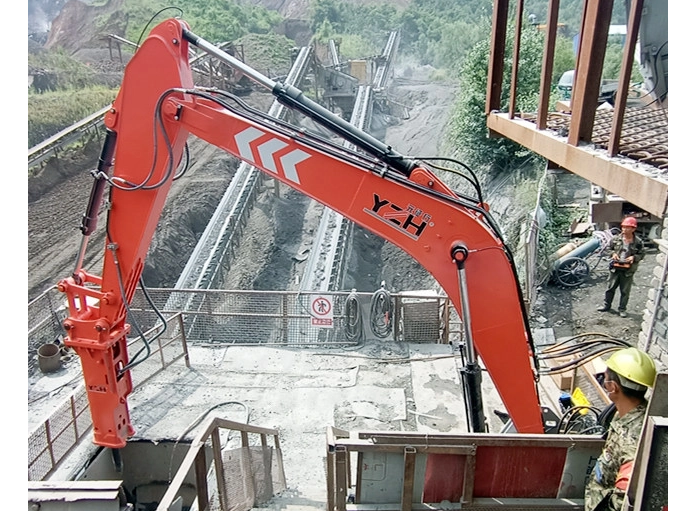
The Solution: Hydraulic breakers allow for "mechanical excavation." In scenarios where material is fed into a crusher system within the tunnel, a compact Rock Breaker Booms System can be installed to manage oversize rock at the grizzly, ensuring the conveyor systems never clog deep underground.
Demolition is no longer about brute force; it is about surgical precision.
The Application: Rockbreakers are used to dismantle old buildings piece by piece. They can selectively break reinforced concrete beams and columns while leaving surrounding structures untouched.
The Benefit: This controlled approach is significantly safer than using a wrecking ball or explosives, preventing collateral damage to neighboring properties.
Modern construction prioritizes sustainability.
The Process: Demolished concrete and brick are no longer just "waste."
The Application: Rockbreakers process this debris on-site, stripping concrete away from steel rebar. The concrete is then crushed into aggregate for reuse.
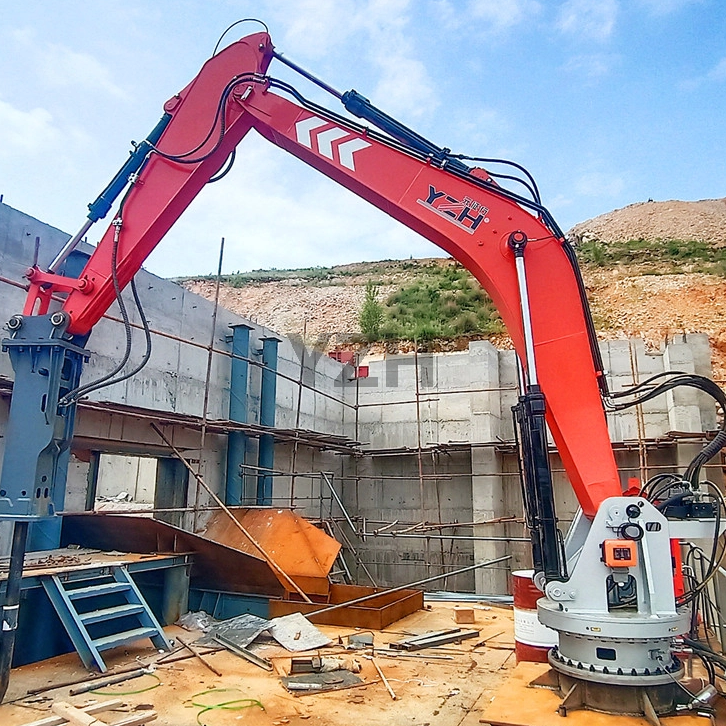
The Equipment: For large-scale recycling yards, a stationary Rock Breaker Booms System mounted over the impact crusher ensures that large slabs of concrete don't block the intake, keeping the recycling plant running at full capacity.
Unexpected obstacles can kill project momentum.
The Scenario: Discovering a massive subterranean boulder or an old concrete footing during excavation.
The Fix: A rockbreaker can be deployed immediately to reduce the obstacle into manageable pieces for the loader. This capability minimizes downtime and keeps the fleet of dump trucks moving.
Construction in dense city centers faces strict regulations.
The Issue: Traditional blasting causes ground vibration and noise that disturbs residents and sensitive electronics in nearby buildings.
The Advantage: Rockbreakers offer a "low-impact" alternative. They produce significantly less vibration than explosives and, when equipped with noise-suppression housing, allow construction to proceed in high-density urban areas without violating environmental codes.
The Rockbreaker is a versatile powerhouse in the construction industry. From the initial ground-breaking of a foundation to the final recycling of demolition waste, it enhances safety and speed at every stage.
For construction material suppliers and large-scale recycling operations, upgrading to a Rock Breaker Booms System ensures that your crushers—and your projects—never stop due to oversize blockages.
Build smarter, break faster.Explore our range of breaking solutions designed to keep your construction operations moving.
Q1: Can rockbreakers cut through reinforced concrete?
A: Yes. Hydraulic breakers are designed to shatter the concrete, allowing the steel rebar to be separated and recycled. This is a standard practice in demolition.
Q2: How does a Rock Breaker Boom System help in construction recycling?
A: In large recycling centers, concrete slabs often jam the crusher. A stationary Rock Breaker Booms System allows the operator to break these slabs safely from a control room, ensuring the recycling plant runs continuously.
Q3: Is a rockbreaker quieter than blasting?
A: Yes, significantly. While rockbreakers do generate noise, it is localized and can be dampened. Blasting creates shockwaves and ground vibrations that affect a much wider area, making breakers the preferred choice for urban construction.
Q4: What is the difference between "scaling" and "breaking" in tunneling?
A: "Breaking" involves fracturing the solid rock face to advance the tunnel. "Scaling" is using the breaker (or a specialized tool) to knock down loose rocks from the ceiling and walls after excavation to make the area safe for workers.


