Views: 0 Author: Kun Tang Publish Time: 2026-01-30 Origin: Jinan YZH Machinery Equipment Co., Ltd.
For decades, "Drill and Blast" was the default method for moving hard rock. However, as safety regulations tighten and environmental standards rise, the industry is undergoing a significant transformation.
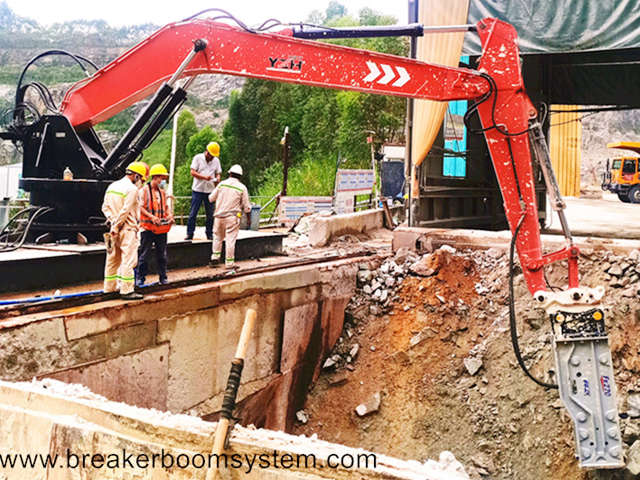
The Rockbreaker (hydraulic hammer) is no longer just a secondary tool—it is becoming the primary solution for excavation and obstacle removal. Whether it is a mobile unit on a construction site or a stationary Rock Breaker Booms System at a mine crusher, mechanical breaking offers a level of control that explosives simply cannot match.
Here is a detailed breakdown of the 7 reasons why rockbreakers are outperforming traditional blasting methods.
Safety is the single biggest driver of the shift away from explosives.
The Blasting Risk: Traditional blasting carries inherent dangers: fly-rock (debris projected at high speeds), toxic fume release, and the handling of volatile chemicals.
The Rockbreaker Advantage: Hydraulic breaking is a mechanical process. It eliminates the risk of accidental detonation and fly-rock.
The Upgrade: With modern Rock Breaker Booms Systems, operators can break rock remotely from a safe, climate-controlled cabin, completely removing personnel from the hazard zone.
Blasting is powerful, but it is blunt.
The Issue: Explosives often cause "over-break"—fracturing rock beyond the intended excavation line. This damages surrounding structures and requires expensive backfilling to correct.
The Rockbreaker Advantage: A rockbreaker allows for "surgical" excavation. Operators can chip away rock inch by inch. This is critical in foundation engineering or tunneling, where you must remove rock right next to existing infrastructure without compromising its integrity.
Construction is moving closer to city centers, where blasting is often prohibited.
The Issue: The shockwaves from blasting can crack the foundations of nearby buildings and shatter windows.
The Rockbreaker Advantage: While rockbreakers generate noise, it is localized and manageable. They produce significantly lower ground vibration compared to explosives. This makes them the only viable option for rockbreaker applications in high-density urban areas, near hospitals, or adjacent to historical landmarks.
Time is money, and blasting is a "stop-start" process.
The Bottleneck: Blasting requires the entire site to be evacuated. Production stops. After the blast, you must wait for fumes to clear and inspect for misfires.
The Rockbreaker Advantage: Rockbreakers operate continuously. There is no need to clear the site or halt other operations.
Mining Context: In quarries, using a Rock Breaker Booms System to handle oversize rock at the crusher eliminates the need for "secondary blasting," ensuring the plant runs 24/7 without interruption.
Sustainability is now a key metric for project approval.
The Issue: Blasting releases nitrogen oxides (NOx) and carbon monoxide, along with massive dust clouds that degrade local air quality.
The Rockbreaker Advantage: Hydraulic breaking produces zero chemical emissions. Dust can be easily managed with simple water suppression systems. This makes rockbreakers the preferred choice for environmentally sensitive projects.
While the machinery requires capital investment, the operational costs are often lower.
The Hidden Costs of Blasting: Blasting requires expensive permits, specialized blasting engineers, high insurance premiums, and strict storage security for explosives.
The Rockbreaker Advantage: Rockbreakers reduce the need for specialized personnel and lower insurance liabilities. Furthermore, by producing more uniform debris, they increase the recyclability of materials, reducing waste disposal costs.
Not every site can accommodate a drilling rig.
The Flexibility: Rockbreakers can operate in confined spaces, underwater, or on steep, uneven terrain where setting up a blast pattern is impossible.
The Application: From digging narrow utility trenches to clearing blockages inside a tunnel, the adaptability of a Rock Breaker Booms System allows it to solve problems that explosives cannot reach.
While blasting will always have a place in massive open-pit extraction, the Rockbreaker has proven to be the safer, cleaner, and more precise alternative for the majority of modern industrial tasks.
For mining and quarrying operations specifically, replacing secondary blasting with a stationary Rock Breaker Booms System is the most effective way to boost uptime and protect your workforce.
Ready to eliminate the risks of blasting?Explore our advanced breaking solutions designed to deliver power without the danger.
Q1: Is a rockbreaker slower than blasting?
A: For massive bulk excavation, blasting moves more material at once. However, for precision work, trenching, or secondary breaking, a rockbreaker is faster because it eliminates the downtime associated with site evacuation, wiring, and safety checks.
Q2: Can a Rock Breaker Boom System replace secondary blasting entirely?
A: Yes. In most mines and quarries, "oversize" rocks were traditionally blasted. Installing a pedestal boom at the crusher or grizzly completely eliminates the need for this dangerous practice.
Q3: How much quieter is a rockbreaker compared to blasting?
A: Blasting creates a high-decibel shockwave that travels for miles. A rockbreaker's noise is mechanical and localized. With sound-suppressed housing, rockbreakers can operate within city noise ordinance limits.
Q4: Is rockbreaking cheaper than blasting?
A: It depends on the scale. For small to medium volumes, or complex environments, rockbreaking is cheaper because it avoids the high fixed costs of permits, security, and blasting consultants.