
Views: 0 Author: Kun Tang Publish Time: 2026-01-27 Origin: Jinan YZH Machinery Equipment Co., Ltd.
Every enduring structure—whether a skyscraper, a bridge, or a residential complex—relies on one thing: a solid foundation. However, the geological reality of construction sites is rarely perfect. Contractors often face hard bedrock, frozen soil, or hidden concrete obstacles that standard excavators cannot penetrate.
This is where the Rockbreaker becomes the most valuable tool on site.
In foundation engineering, the ability to modify the ground conditions efficiently determines the project's timeline and safety. From mobile units digging trenches to stationary Rock Breaker Booms Systems managing debris flow in underground projects, this technology is the backbone of modern ground preparation.
Here are the 6 specific ways rockbreakers drive success in foundation engineering.
The primary goal of foundation engineering is to reach a soil or rock layer with sufficient bearing capacity.
The Challenge: Often, the stable bedrock is uneven or located beneath layers of hardpan soil.
The Application: Rockbreakers are used to fracture and level this hard material. By creating a flat, stable surface on the bedrock, they ensure the building load is distributed range evenly, preventing future settling or structural cracking.
Unexpected discoveries are common when breaking ground.
The Scenario: Excavation teams frequently encounter "floaters" (large isolated boulders) or old, buried concrete footings from previous structures.
The Solution: Instead of halting the project to bring in blasting crews, a rockbreaker can immediately pulverize these obstacles.
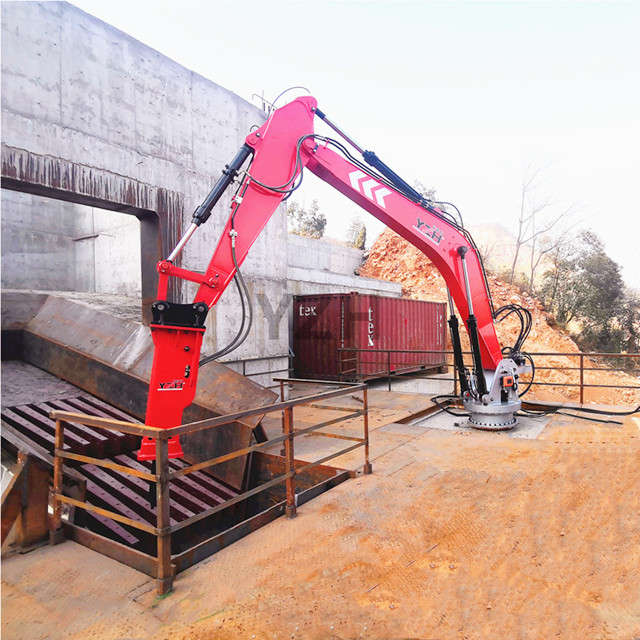
Advanced Application: In large-scale foundation projects where excavated rock is processed on-site for reuse, a Rock Breaker Booms System mounted over a mobile crusher ensures that these large obstacles don't jam the crushing equipment, maintaining a continuous workflow.
Foundations are not just about concrete pads; they are about connectivity.
The Role: All modern structures require deep trenches for water, sewage, and electrical conduits.
The Precision: Unlike blasting, which causes "over-break" (damaging the surrounding rock), a rockbreaker can carve a precise, narrow trench through solid rock. This reduces the amount of backfill material needed and lowers overall concrete costs.
For deep basements or subway foundations, the work moves underground.
The Application: In confined underground spaces, rockbreakers are used to advance the tunnel face and shape the walls.
Grid Safety: In these environments, Rock Breaker Booms Systems are often installed on "grizzly" screens to break excavated rock before it is transported to the surface. This prevents blockages in the material handling system, which is critical in the tight constraints of a tunnel.
Foundation engineering often involves "retrofitting" or strengthening existing bases.
The Task: Removing a specific section of an old concrete foundation without damaging the steel reinforcement or the surrounding structure.
The Method: Rockbreakers allow for surgical demolition. Operators can chip away concrete inches at a time, exposing the rebar for inspection or connection to new concrete pours.
Safety is the non-negotiable aspect of foundation work.
Risk Reduction: Traditional methods like blasting release toxic fumes, fly-rock, and ground vibrations that can destabilize nearby buildings.
The Advantage: Rockbreakers provide a controlled, mechanical alternative.
Remote Safety: With the integration of modern Rock Breaker Booms Systems, operators can break rock from a remote distance or a protected cab, completely removing them from the risk of falling debris or dust inhalation.
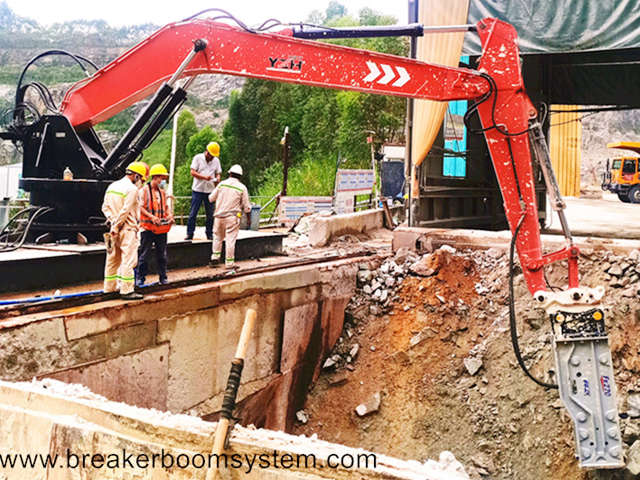
In foundation engineering, the Rockbreaker is more than just a demolition tool—it is an instrument of precision and stability. It allows engineers to conquer difficult geology, ensuring that the structures built today will stand the test of time.
Whether you are trenching for utilities or managing excavated rock flow with a stationary Rock Breaker Booms System, choosing the right breaking technology is the first step toward a successful project.
Build on solid ground.Explore our heavy-duty breaking solutions designed to handle the toughest geological conditions.
Q1: Can rockbreakers be used in residential areas?
A: Yes. Unlike blasting, which is often banned in residential zones due to vibration and noise, rockbreakers are a compliant solution. Modern breakers can be equipped with noise-suppression housing to meet urban noise regulations.
Q2: What is the advantage of a Rock Breaker Boom in foundation work?
A: While mobile excavators dig, a stationary Rock Breaker Booms System is essential if the project involves on-site crushing of excavated material. It ensures the crusher runs 24/7 without blockages, speeding up the removal of debris.
Q3: How deep can a rockbreaker work?
A: A rockbreaker can work as deep as the excavator arm allows. For very deep foundations or caissons, telescopic boom arms or specialized long-reach excavators are used to reach the bottom of the excavation pit.
Q4: Does rockbreaking damage the surrounding soil?
A: Minimal damage occurs compared to blasting. Rockbreakers deliver directed impact energy, meaning the surrounding soil integrity remains largely undisturbed, which is critical for the stability of the foundation walls.


