Views: 0 Author: Kun Tang Publish Time: 2026-02-03 Origin: Jinan YZH Machinery Equipment Co., Ltd.
In the mining and construction industries, a hydraulic rock breaker is not just an accessory; it is your insurance policy against downtime. Whether you are clearing a jammed jaw crusher or excavating a foundation, the wrong equipment choice can lead to frequent breakdowns, safety hazards, and lost revenue.
However, with hundreds of models and configurations available, selecting the right unit can be overwhelming.
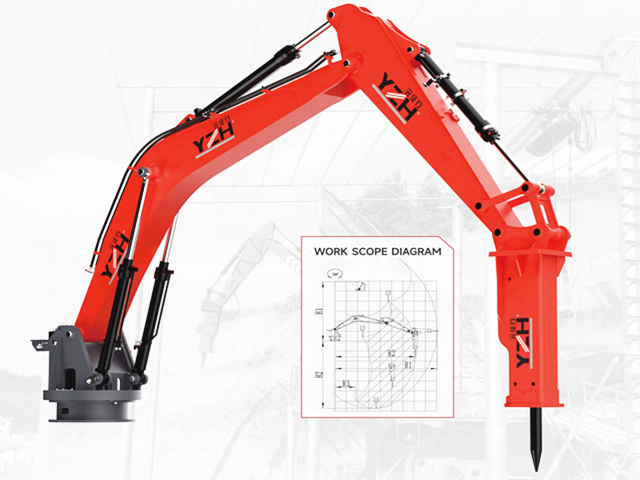
This guide breaks down the critical factors you must evaluate—from environmental constraints to long-term cost benefits—to ensure you choose a Rock Breaker Booms System that fits your specific operational needs.
The first step in selection is not looking at the machine, but looking at your site. The "where" dictates the "what."
The Challenge: Are you working in a wide-open quarry or a confined underground tunnel?
The Selection: For stationary applications (like crushers), you must calculate the "Working Envelope." The boom must be long enough to reach the furthest corner of the breaker box or grizzly screen but compact enough to park safely out of the way during maintenance.
Key Insight: A Stationary Rock Breaker Boom is often superior to a mobile excavator in tight crusher plants because it occupies a fixed, small footprint and doesn't require maneuvering space.
The Challenge: Breaking soft limestone requires different force than shattering granite or basalt.
The Selection: Assess the Compressive Strength of your rock. High-mpa rock requires a larger hammer with higher impact energy (Joules). Using an undersized breaker on hard rock causes overheating and premature failure.
Once you understand the environment, you must choose the deployment method. This is often the biggest decision for plant managers.
Pros: Versatile; can drive to different parts of the site.
Cons: High fuel consumption; ties up a valuable excavator; operator is exposed to vibrations; inconsistent availability (the excavator might be busy elsewhere when a jam occurs).
Pros: Dedicated to one task (usually the crusher); electric power (lower cost); remote operation (safer); instant availability.
Performance Verdict: For rockbreaker applications involving primary crushers, grizzlies, or ore passes, a dedicated Rock Breaker Booms System is the industry standard for efficiency.
Smart buyers look beyond the initial purchase price. You must calculate the Total Cost of Ownership (TCO).
Fuel vs. Electric: A diesel excavator idling while waiting for a jam burns fuel and money. A stationary electric boom consumes power only when working. The energy savings alone often pay for the unit within 18-24 months.
Maintenance: Mobile units have tracks, engines, and transmissions that need servicing. A pedestal boom has fewer moving parts, significantly reducing maintenance hours.
The Calculation: If your primary crusher stops for 20 minutes to clear a blockage manually, how much production is lost?
The Value: If a Rock Breaker Booms System clears that blockage in 2 minutes, the ROI is immediate. The system pays for itself by keeping the main production line moving.
Choosing the right hydraulic rock breaker is a balance of power, reach, and economics.
Analyze your rock: Ensure the hammer has the impact energy to break your specific material.
Measure your reach: Ensure the boom covers the entire hazard zone.
Calculate your ROI: Consider the long-term savings of electric, stationary systems over diesel mobile units.
Don't guess when it comes to productivity.Equip your site with the right tools.Visit our product page to compare specifications and find the Rock Breaker Booms System that aligns with your production goals.
Q1: How do I determine the correct boom length?
A: You need to measure the distance from the proposed mounting position to the furthest point in the crusher box or grizzly that needs clearing. Always add a small buffer to ensure full coverage.
Q2: Can I install a rockbreaker boom on an existing crusher structure?
A: Yes, in most cases. However, the supporting structure must be reinforced to handle the reaction forces and vibration of the boom. We recommend consulting with our engineers to assess your current steelwork.
Q3: What happens if I choose a hammer that is too powerful?
A: An oversized hammer can send excessive shockwaves back into the boom arm and the crusher structure, potentially causing fatigue cracks in the steel. It is vital to match the hammer size to the application, not just buy the biggest one available.
Q4: Are stationary systems difficult to operate?
A: No. Modern systems come with intuitive joystick controls. They can be operated from a comfortable control room, often using cameras, which makes them much easier and safer than operating a mobile excavator in a dusty environment.